Out in It

Before I left for a recent backpacking trip in Colorado, someone asked me what I liked about hiking in the wilderness. The seemingly easy question stumped me. The phrase that came immediately to mind—“It’s great to be out in it”— makes perfect sense to me but is less than understandable to someone who’s never been.

Vista of mountain peaks
The view from the Continental Divide near Williams Lakes in the Weminuche Wilderness, Colorado. Photo by Lizzie Henry.

The key lies in the prepositions “out” and “in.” The “in” speaks for itself: in a meadow bursting with purple and yellow wildflowers, in the presence of a bald eagle soaring over the shore of a lake tucked against the flank of a mountain, in the midst of an endless panorama of peaks stretching away in every direction.

It seems the “in” would be enough, but you can get most of that on a day hike. The “out” is equally important: out of daily routines and obligations, out of a habitat created by humans, out of the endless string of decisions we think are so important. Once you’ve packed your bag and hiked a few miles, the number and type of choices you have is dramatically reduced: where to sleep, how to cross a stream, whether to eat freeze-dried lasagna or chicken teriyaki for dinner. The things you do are equally basic: walk, pitch a shelter, cook food, sterilize water.
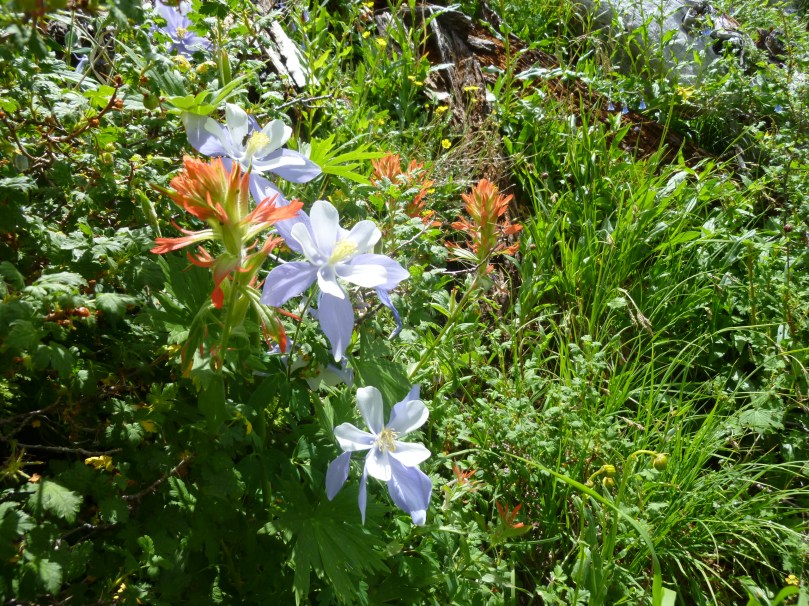
Columbine and Indian paintbrush
Columbine and Indian paintbrush. Photo by Lizzie Henry.

I feel free when backpacking, unencumbered despite the heavy pack. Perhaps this feeling comes from letting go of some control and focusing for a while not so much on what or how well I am doing as on simply existing.

It would be misleading to say that it was an idyllic trip. We argued. I worried about whether the route I had chosen would work. I packed too much trail mix. I fell in the mud.

But something about the beauty of the place and the simplicity of the way of living made it so much easier to see how small those things were. The important things were clear: the fragile beauty of the columbine, the joy of one of my companions who jumped up and down with her 35 pound pack on when she got her first glimpse of the vista from the atop the Continental Divide.

It’s great to be out in it.

Who’s Throwing the Party

I had the urge to perform a random act of celebration at work the other day. As a friend was walking toward me, I suddenly wanted to shout her name out with great exuberance and throw my hands into the air. I hesitated because, after all, this was work, and that’s not exactly how one behaves at work.

So I announced her name to the hallway with less than the trumpet blast of volume I’d first considered and raised my arms—not too quickly—into the air with less than all-out enthusiasm.

She looked worried and said, “What do you need?”

“Nothing,” I said, “I’m just celebrating your presence.”

“You must need something,” she said.

I wonder how many times God and I have had a similar conversation without my being aware of it. I suspect God is always rejoicing in the great good news of our existence. My most likely response to this outpouring is “What do you need?” as if I had to do something to earn that goodwill.

I can fool myself into thinking I’m being responsive or responsible asking that question, but really I’m being a control freak. If I can earn God’s favor, then I am in charge. If, on the other hand, we recognize that God’s love is unreasonable, is always pouring out regardless of what we do, our whole world shifts.

Life is no longer about getting it right because as Richard Rohr says, “God does not love us because we are good; God loves us because God is good.” When we stop worrying about what we’re supposed to be doing, we’re free to participate in whatever God is doing, to enter the divine flow, to throw up our arms and say, “I praise you God for I am wonderfully made” (Psalm 139).

I don’t mean we have free license to treat other beings or the Earth poorly. God’s not throwing that kind of party.

Pierre Teilhard de Chardin said, “Joy is the most infallible sign of the presence of God.” Perhaps the joy he is talking about is the kind that would arise if we stopped wondering what we needed to do to be good and entered into God’s celebration.

Can We Care Enough?

I don’t write about current events for a number of reasons: because a lot of other people do, because I’m often not well-informed, and because when I write about others’ actions I tend to blame and judge, which is not helpful. But it seems ridiculous to write a blog on July 7, 2016, that does not take into account the killings of black men on July 5 and 6 in Baton Rouge and St. Paul.

The problem is, I am white. I will never know what it means to worry that, despite all my warnings, my son will leave his hoodie on as he walks to school leaving me to identify his body that night instead of feed him dinner.

I read an op-ed in the New York Times by Michael Eric Dyson, a black sociology professor at Georgetown University, who had little patience for white people who understand privilege because we aren’t doing anything. He said, “We don’t know…how to make you [white people] care enough to stop those who pull the triggers.”

“Care enough”—this is not a policy matter; this is a matter of the heart. Can I truly say that there is nothing of me reflected in the actions of these police officers? I hope I wouldn’t have acted as they did, but until I can love my neighbor as myself—not as much as myself, as Cynthia Bourgeault once explained, but as myself, that is, with a knowing that my neighbor is more myself than other—until I can do that, I am participating in this and all the violence in the world.

So how not to crawl into bed and pull the blanket over our heads because if you are like me, you know that perfection is not within your reach. My prejudices are legion, and they’ll never fully go away.

As my friend Barb Kollenkark wrote recently, the only healthy way to deal with darkness is to bring it into the light. Can we care enough to recognize and act with love toward our own darkness? Loving is not condoning. Loving is seeing it as it is—the woundedness that lies beneath it as well as the harm we have caused and are causing.

I doubt any of this would offer comfort to the loved ones of Alton Sterling and Philando Castile, nor, perhaps, should it. It is ours, white people’s, to bear the discomfort of what we have done—not by wallowing in guilt but by acknowledging our responsibility—to ask for God’s undeserved grace to heal us—because surely if we have done these things we are sick—and to act from this new place in a way that can help those we have decimated. “A pure heart create for me, O God.”

Being Incomplete

A professor working on the effects of sunspots on Earth’s soil said something like this to me this week: “You know the sun is about halfway through its life [I didn’t], so in five billion years….” When I heard “halfway through its life” I thought, this whole end of the solar system thing is closer than I realized. Then came the five billion years.

Also this week a friend sent a prayer written by Pierre Teilhard de Chardin, the first line of which I’d heard before: “Above all, trust in the slow work of God.” Fourteen billion years-ish so far—slow indeed. I worry about the way weeks and months speed up, seeming to contain less time every year. As they age, the stars say to each other, wow, a million years is just nothing anymore.

Teilhard’s advice is not surprising coming from a paleontologist and priest, nor is the end of the prayer:

Only God could say what this new spirit
gradually forming within you will be.
Give Our Lord the benefit of believing
that his hand is leading you,
and accept the anxiety of feeling yourself
in suspense and incomplete.

“A new spirit gradually forming within you”—something that is not there now and has not been there before. That’s remarkable. The sun may apparently stop having sun spots right about now—give or take a few thousand or maybe million years—as this is something that can happen to stars halfway through their lives. Something new after five billion years, something gradually forming.

“Accept the anxiety of feeling yourself in suspense and incomplete.” Whatever this new spirit is, it will never be complete, will never come to a point of stasis. I don’t know whether the sun feels anxious, but its formation—its birth—involved an epic, fifty-million-year struggle between gravity and fusion energy. And now it exists by burning itself up. It will die, but it will never be complete.

We are not somehow separate from this existence we find ourselves in. We are part of a grand becoming that has little or nothing to do with the way we want things to be or think they should work.

Over the next billion years, the sun will heat up and Earth will become inhospitable to life as we know it long before the sun engulfs the planet. “Give Our Lord the benefit of believing that his hand is leading you.”