Eulogies

I’d like to give a shout out to two fine souls, Mickey and Rob, who passed out of this life last week.

Mickey likely knew of me most of my life—so it goes in a town of 7000. I didn’t know her until I joined the local writing group in my early twenties.

She had an incredible humility and sense of humor about herself that I always admired. She lived a unique life with a great deal of courage and spunk, but she’d never quite believe a compliment.

Her prose resembled her personality—down-to-earth, straightforward, funny, and profound. She could spin out a scene so that you knew exactly where those clueless characters were heading and couldn’t wait to see how they made a mess of things because it was going to be funny.

You also knew everything would come out OK in the end, if only because at least one of her characters, like her, knew better than to get riled up about things.

When Mickey was amused by some outlandish suggestion I’d made, she’d always say, “Well now, Rachel, I don’t know about that” with a big smile on her face. She said it with a certain timbre and cadence that in a less resolute woman might have been wavering. But there was nothing wavering about Mickey.

Rob I knew for about eight years. His wife and I started a writing group together, and they would take me out for breakfast sometimes after mass.

He was a doctor and worked at the state hospital—an all-male, maximum-security psychiatric facility—well into his seventies. Given the difficulty of finding people willing to work there, he gave the patients and staff a tremendous gift.

He had this wonderful habit of talking about everything in exactly the same way. He’d be rattling off medical facts or expressing a deep cynicism about the current political climate, and in the next breath, without a beat or change of tone, he’d describe a mystical experience he’d had. Those sudden turns never failed to surprise me

When something tickled him, his usually serious face lit up in the most marvelous way. He became half elf, half six-year-old, delight beaming out of him.

I’ll never hear them laugh again, but if to live well is to always continue growing into yourself, they both made an excellent go of this turning ’round.

Mickey and Rob, I will treasure you always. God speed.
Beyond Annoying

One possible moral of the story: annoying people may be just the ones who save your life. At least that was my conclusion at the end of The Way, directed by Emilio Estevez and starring Martin Sheen.

Sheen plays a doctor, Tom, whose son dies during a pilgrimage on the Camino de Santiago in Spain. When Tom goes to collect the body, he decides on a whim to walk the route with his son’s ashes.

Along the way, he meets three annoying fellow pilgrims. One is overly friendly-annoying, one is mean-annoying, and one is just straight up, full-of-himself-annoying. They form a little community that Tom tries to avoid being part of. Then one day, they take care of him when he can’t take care of himself, and he begins to see and appreciate their good-heartedness.

I would like to remember more often to look at people’s hearts instead of their failings. I have developed my fault-finding capabilities well beyond a useful level.

Seeing others’ shortcomings is easy because we all have them. It takes a little more attention to focus on what’s wonderful about a person, to let their quirks roll by while recognizing their gifts, or to simply enjoy the whole person, the jumble of flaws, talents, and grace that we all are.

A caveat: I’m not talking about the people who suck the life out of you or make you feel constantly inadequate or afraid. Those people aren’t annoying; they’re toxic. If you want to work your way up to finding the good in toxic people, I recommend doing it long distance without any actual communication.

After his fellow pilgrims rescued Tom, they all picked up their bags and kept walking. Because we are all on the same road and like it or not, we are on it together.

Dig In

This may change in a few months, but right now, summer is my favorite season. It has earned this accolade by mastering the most important criteria of all: food.

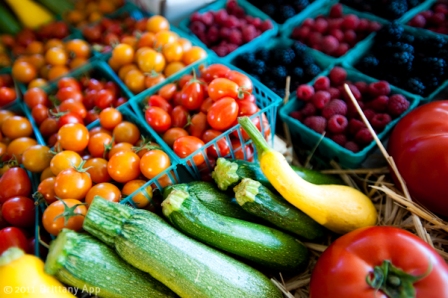
produce at a farmer's marketThe August issue of Bon Appetit arrived sporting a picture of an heirloom tomato sandwich so drool-inducing that any sane person must have been tempted to eat the cover. When I made their tomato, raw corn, avocado salsa (with lime juice and, if you insist on ruining it, cilantro and serrano chilies), it looked just like the picture. I do not make food that looks like pictures. Martha Stewart crosses the street when she sees me coming. The food this time of year is just that beautiful.

In summer you can make things like buckwheat pancakes with fresh peaches and cardamom cream syrup, if you have cream, which I didn’t, so I can’t report on them. But just saying fresh peaches, cardamom, and cream in the same sentence lifts my heart (recipe from Cook This Now by Melissa Clark).

This evening I was slicing some squash for future use (don’t worry, I won’t let this one, ecstatic moment of advance preparation go to my head). The deep yellow of the squash was such a clear, visual sign of overflowing goodness that I had to eat one of the raw spears even though I was in the middle of my third chocolate chip cookie.

Last weekend I spent way too much money at the farmer’s market; way too much is the amount that buys more food than I can eat before it goes bad. But how do you choose among raspberries, peaches, Santa Rosa plums, Early Girl tomatoes, and fresh corn? That’s right, you don’t. Yum!

Plus I have these amazing friends who, unlike me, grow things. The sunshine-in-flesh-form squash mentioned above came from a coworker’s mini-farm. Another friend grows scarlet runner beans, which are green on the outside, pink on the inside, and more delicious than any other green bean ever. Yes, ever.

To top it off, while entertaining your tastebuds, you can also sit outside and be warm (except maybe in certain parts of northern California). So rejoice! Summer is celebrating and we’re invited.

Creeping Contentment

Last Saturday I had a few moments of not wanting my life to be any different. And even worse, I was not at all scared of this clearly unreasonable contentment.

You might be saying to yourself, but why is this unreasonable? Your life is pretty darn good. Yes, actually, it is, but popular thought in my brain holds that if you say that above a whisper, the complacency monster will jump out and gobble you up.

Though a few weeks back I proposed observing my life to see whether anything was truly running amuck, I didn’t really intend to do that for more than a couple of days. Any longer and this whole acceptance thing could get way out of hand.

Then obligation and discipline both took a long vacation. Two people I told about this said, “Oh, it’s summer,” dismissing any need for continuous improvement for at least another month.

So I floated around for a couple of weeks, not trying to increase my holiness quotient, reduce my impact on the environment, clean, or win a Nobel Prize. In other words doing what I usually do but with much less guilt.

Come Saturday I had succumbed to such an extent that I thought, wow, I like this. Even my usual “you will become an eternal couch potato of contentment” thoughts seemed inconsequential and possibly unlikely.

Couch potato fear does have reinforcements. The next attack goes something like, but you haven’t achieved everything you said you wanted to and since you are not a) actively pursuing it or b) feeling like you should be actively pursuing it, you are screwed.

I suppose this may be true. It may also be true that enjoying where you are helps you get where you want to be. But don’t tell anyone I said so.

Ode to Friends

To really milk your birthday to its utmost potential, don’t organize your own party. That way, multiple small groups of friends will take you out for a lot of individual birthday meals.

This lack of planning also gave me a lot of chances to think about how great my friends are—and not only because they were feeding me. Here are just a few of the ways they are awesome.

They are courageous. Whether traveling through a developing country in a wheelchair, caring for an elderly parent, or facing their own death, they complain little.

They don’t deny the difficulties of life but don’t dwell on them too much. They allow anger and grief and joy and love and can laugh at the ridiculous during good times and bad.

They work hard and care not only about the quality of their work but also about how they treat those they work with. They don’t spend much time blaming other people.

They are willing to change their minds after reflecting on something and regularly take the time for that reflection.

They are funny and kind and resilient and generous and they make me laugh. And the crowning achievement—they like to eat and cook really well.

To steal a few brilliant phrases from a graduation speech by a young woman named Rebekah Frumkin who is much smarter than I was at twenty-two, my friends “[square] the serious with the silly” and “[view] the world with humility and candor” (from a commencement address given at Carleton College).

All this helps me inch toward accepting that life is not about having everything work out well for everyone—as defined by me—but about how we react to the highs and lows. Not because I like it or it makes sense. Not because the highs and lows aren’t real but because they are and life is simply more enjoyable when we focus our mental and emotional energy on the things we’re grateful for, like amazing friends.

Help Matters

Sometimes crappy things just happen. I did not come up with this idea. Someone has made millions of dollars marketing products espousing various forms of that sentiment.

I recently watched a Zulu language film called Yesterday about a woman in a tribal village in South Africa who contracts AIDS. Though not based on any one person’s true story, I’m sure it’s a true story many times over.

The main character, Yesterday, is patient and wonderful and gets this disease that entails more suffering than those of us with access to hospitals and morphine will ever guess at. It’s hard not to wonder why the world is not more justly constructed after watching this story.

As the priest Anne Lamott quotes in one of her essays says, why is not a useful question, though I still want to know the answer. Seeing as I am not likely to get it, I decided to review what I think I know.

Here are some things I don’t believe:

  • God tests us.
  • God gives us trials to strengthen us.
  • Bad things happen so that good things can come from them.
  • We attract—through our attitudes, beliefs, or ways of living—everything that happens to us. Some things, sure, but not everything.

Here are some things I do believe:

  • Grace happens.
  • There are things that help.
  • These things are extremely important even though they appear small.

It helps to cry or yell or beat the pillow. It helps to lay all the crappiness before God and say, “What the hell? Would you do something about this please?” It helps to eat a hot fudge sundae with a friend or go for a hike.

Help doesn’t mean that the situation changes, that a miraculous healing occurs, that the next day a job offer arrives out of the blue. Those things may happen, but a lot of the time they don’t. More often, we feel less alone and more able to keep going.

That seems insufficient in the face of the AIDS epidemic in Africa or any number of other global disasters, but an epidemic is composed of individuals. In the movie, one person stands by Yesterday. When they are together the awfulness lifts a little. Bring on the hot fudge.

Celebrate Your Life

Birthdays can be a time for reflection, but this year I’m opting for celebration. Some cool things that happened on or near my birthday:
•    My van erupted into spontaneous song on hearing news of the occasion.
•    A friend sent me a picture of her smiling, swinging baby with good wishes.
•    Three friends from two very different times in my life met each other in Johannesburg, South Africa.
•    My team won the over-30s division of the local soccer tournament.
•    I discovered someone in my new office has the same birthday I do. As a result, we got both a birthday breakfast and a birthday lunch. I think that’s what they mean when they say nirvana.
•    A friend baked me some healthy yet surprisingly tasty cookies, which is particularly impressive because I am generally opposed to combining the concepts health and dessert.
•    My mom took me out to dinner, and we had completely unhealthy chocolate torte with hazelnut mousse. Yum.
•    Another friend sent me this blog post by someone who spent her birthday doing random acts of kindness.
•    A number of people wrote cheerful texts.
•    My dad called.
•    The answer to one of life’s great mysteries—who buys Christmas ornaments in July?—was answered when my mom and sister bought me some I’d been eyeing in San Diego.

According to this list, what’s going to make the next year enjoyable is chocolate cake. That and the people who surround, nurture, and support me, who make me laugh and do me perhaps the greatest favor any of us can do for each other—keep me in mind, whether they are near or far.

And all of this for someone who only remembers others’ birthdays about fifty percent of the time. Thanks, everyone.

Laugh Until It Hurts

Silliness apparently runs in my family. My mom, sister, and I traveled to San Diego last week. The most enjoyable part of our trip was neither the feats of marine mammals at Sea World nor the amazing Afghani food we ate, well, devoured (at Chopahn if anyone’s San Diego bound). The best moments had more to do with hobbits.

I don’t remember what inspired the first Golem impression of the trip, but that one inspired many others. They all had us laughing in that way that makes everyone around you in the restaurant either very envious or very nervous. The kind of laughter that makes you cry, the kind where you look at each other, not really sure why or whether the cause is hilarious enough to merit this reaction but nonetheless grateful for how good it feels.

This laughter differs from that invoked by even the funniest movie or most clever comedy routine. It has a refreshing quality, like dipping your soul in a mountain spring. No one would choose the Henry women over Robin Williams for a night of entertainment, yet when each of us curled her lips, rolled her eyes back in her head, and located her throatiest voice, we were, at least to ourselves, the funniest act around.

I suspect we could all use more of this breath-taking fun. I wish I could bottle it or write a recipe: mix three parts friends or family with two parts shared experience; add a day of relaxation and three drams silliness; mix.

The magic seems to arrive when it will, though, and the unexpectedness of finding yourself struggling for oxygen and wondering whether your abs will be sore the next day only makes the moment that much more precious.

Giving In

Have you ever had a day when every attempt at productivity forced you to the bottom of an ocean of frozen molasses? My mom and I call that a 20% day. Don’t fight the 20% days. They are Muhammed Ali or Mike Tyson, and you are a featherweight.

The term 20% days comes from Anne Lamott’s book Plan B. In one of her essays, she tells the story of David Roche, who leads the Church of 80% Sincerity. He preaches that eighty percent of the time, we can strive to improve ourselves or attempt other noble actions, but 20% of the time, nobility will likely escape us. And that is OK.

Telltale signs of a 20% day:

  • Approximately nothing can inspire you to get out of bed, and you are not sick.
  • After you manage to get up and have breakfast (serious bonus points for anything beyond cold cereal or toast), putting your dirty dishes in the dishwasher requires herculean effort.
  • When you try to convince yourself you can achieve any of the tasks on your list, your head threatens to explode.

Solution:

  • As soon as you feel your head reaching exothermic potential, desist all thoughts of productivity. It is really, really helpful when 20% days arrive on the weekend.

As you may have guessed by now, I had a 20% day recently. It took me half an hour of lying in bed to recognize it and another 15 minutes to remember the bit about Mike Tyson. Fighting is tempting because it feels as if you will never find the motivation to get out of bed, but if you wait, the time will arrive.

I got up and made breakfast (bonus points for me!) and forgot again that resistance is futile. So I sat in my chair after breakfast feeling as if I should do something. Then I remembered to concede to the inevitable and spent more time in my chair not feeling as if I should do something.

That was my breakthrough moment: 20% days do not have to suck. If you don’t try to produce Nobel Prize winning research or clean behind the stove, they can be remarkably pleasant, somewhat foggy and definitely not productive, but pleasant.

And remember, 20% is one in every five days. If you’re basically functional for a week straight, you’re an overachiever.

Hold Still

You might think that after thirty-two years of playing soccer, enjoying it would no longer surprise me. But I strive not to be that sensible.

Driving home from a game the other night I thought, “That was fun.” The thought is not new, but this time I paused long enough to let it expand into some open space in my brain, space that is usually occupied by other, less fun thoughts, such as, how can I exercise more, write more, eat more vegetables, and have more down time? In my next life I want to worry about why I can’t do less, just for variety.

Quality improvement processes go like this: look at what’s happening, see which part is broken, figure out a possible solution, try it, check to see whether it’s working. My brain, on the other hand, goes like this: assume nothing is as good as it could be, come up with twenty-five hours worth of daily improvements, begin system overload due to attempted expansion of space-time continuum, scramble to scale back and prioritize, fail, shut down system, reboot and run again. I am pretty sure I found this method in the Tao Te Ching or Bhagavad Gita.

That momentary space in my brain allowed me to wonder whether anything actually needs to be improved. Might it be possible that I am healthy enough, accomplishing enough, treating others well enough? And if so, what do I do about it?

Because it only took a few minutes to realize that everything being OK is pretty scary. What happens next if we’re OK? What is there for us to DO? How can we prove our worth? What will prevent us from sitting on the couch eating potato chips to the exclusion of all else?

Age-old wisdom aside, I think I’ll risk living my life exactly the way it is for a few months and check to see whether, just maybe, everything’s OK.