Letting Life Be

When we returned to the vanpool stop, a.k.a. the Walmart parking lot, one evening this week, two baby and two adult birds—a kind I’d never seen before—appeared to be searching for each other with no success even though they were only a few feet from each other.

The babies were tiny, still fluffy, and looking as if they shouldn’t have been out of the nest. They had somehow gotten onto the pavement while the adults were up on the grass in one of those small islands of partially neglected nature that we interestingly dot our parking lots with. The babies were so small they couldn’t get from the pavement to the grass because the curb was taller than they were, maybe three or four inches, no taller than my shoe.

The adults appeared to be calling and looking for the babies but never in the right direction. It’s possible the adults and babies literally couldn’t hear each other because of the noise from the nearby highway. I wanted to show the adults how to search visually for the babies, how to methodically cross and recross a space the way humans do. I wanted to lift the babies up onto the grass that they kept trying to look over the impossibly high curb to see.

But I know just enough about nature to know there was no way to help. Touching the babies would make them smell like human, and their parents might reject them, never mind the perhaps impossible task of catching them. The parents would probably not interpret my attempts to guide their search as anything other than a threat. In reality, I didn’t even know whether they were really lost or this was just part of how these baby birds grow up, a type of being pushed out of the nest.

I think this is so often true, that there’s nothing we can actually do to change the course of things unfolding in this existence, though we’re trained to think we can. I don’t mean that we never affect each other or that one person’s generosity can’t completely change the course of another’s life. Those things happen all the time, but this helplessness is also true, and perhaps at least as often. Maybe the only thing we can do when we find ourselves next to an impossibly high curb or watching a loved one search for something we are powerless to provide is remember that everything we are looking for is only three feet away.

As William Stafford says in the final stanza of the poem “Afterwards,”

Maybe people have to go in and out of shadows
till they learn that floating, that immensity
waiting to receive whatever arrives with trust.
Maybe somebody has to explore what happens
when one of us wanders over near the edge
and falls for awhile. Maybe it was your turn.

Talking About the Weather

Somewhere in the middle of planning my upcoming trip to the midwest, I thought, “This is a bad idea. It’s going to be very cold there.” An alarming thought for a former Coloradan to have.

You see, in Colorado, we are tough, and those of us from mountain towns have the luxury at scoffing at the rest of the world when an inch of snow shuts down an entire city. We accept no excuses. Twenty-four inches in forty-eight hours? No problem, we say.
But now I live in coastal California where the majority of people understand that it’s simply follish to live anywhere water freezes without the help of GE. Why voluntarily be cold–or hot for that matter? We’ll stick with 70-74 degrees Fahrenheit thank you very much.
Having recently returned from Colorado to California, I’m fairly convinced it’s a miracle people from vastly different climates can even talk to each other. The world makes itself felt in a cold climate in a way we 70-74 degree-ers do not experience. You have to plan the weather into your life with time to scrape the car window and snowblow the driveway. And then there are days you have to cancel your plans on account of Mother Nature just to stay alive. If you ignore the weather in California, you might get wet.
Back in California, I was sitting at a picnic table that the nearby tree had covered with tiny flowers no bigger than my fingernail. Yes, in January, but stick with me here winter people. The flowers looked like little green cups. I picked one up and turned it over and inside a tiny bug was weaving its way through the white stamen, each tipped with a yellow dot, and stopping to clean its wings.
The world must make itself felt in gigantic and mysterious ways to this bug, such as when a strange force literally turns its world upside down. That upturning can happen to any of us, regardless of the weather–a death, a birth, an unexpected success, the loss of a job. And during and around all these events this world that is the source of endless opportunities for wonder, that offers so many tiny bugs in tiny flowers, continues.

There are small mysteries in this life, like why no one can create a generic Ban-Aid that actually sticks to your skin. Then there are the larger mysteries.

Like this one: Did you know that for every kernel in an ear of corn, there’s a strand of silk that brings the pollen to that kernel? Each individual kernel is important enough to warrant its very own pollen delivery system.

corn plant showing silk
By Pollinator at en.wikipedia, from Wikimedia Commons

Those tufts of silk coming out the top of an ear of corn don’t appear all that well organized. It seems altogether possible that one if not many strands would be missed, yet in all the corn I’ve eaten in my life, I’ve seen very few unpollinated kernels. And it’s not as if corn sellers can pick out the cobs with a few unpollinated kernels here and there.

I don’t think understanding the corn fertilization mechanism down to the mitochondria or the molecular exchange across cell walls reduces the mystery of such an intricate system—for every ear in the history of corn!—one bit. If anything, the biological complexity provides more of a sense of wonder, one more opportunity to say how on Earth did it develop the ability to do that?

We sometimes think that if we know the how, we understand the whole, and if we understand it, there’s nothing to marvel at anymore. If we can explain it, we’ve mastered it, and it’s no longer worthy of the same level of respect. We can move on to figuring out the next thing.

But I think that the more we know, the more amazing and mysterious something can become. Corn silk can be transformed from those annoying strings that insist on clinging to your corn to a source of life. How cool is that?

In Praise of Flowers

An incredible row of bearded irises in more than the colors of the rainbow is blooming along the path between the van drop off and my office. Every day my vanmates and I walk by them, we comment on their beauty. Every day, there’s a new facet to notice, a new color opening up to the world. It must be the best way to start the day.

purple irises

A few amazing things about flowers:

Amazing thing number one: irises come in more than one color—burgundy, a purple so deep you can almost taste it, combination packs of dusty red or violet with yellow, a bloom that starts off the palest purple and turns white as it unfurls.

Amazing thing number two: the whole furling business. These large petals start out all folded up in a neat little package. How do they do that?

Amazing thing number three: this is only one kind of flower! We have yet to celebrate the bright orange poppies along the side of the road or the jasmine whose scent is filling my patio with honeyed air or the delicate cherry blossoms that look just as beautiful falling off the tree as in full bloom.

Amazing thing number four: you don’t have to do anything except plant and water them. You don’t have to cajole them or pay them or promise them fame. It’s just what they do.

Amazing thing number five: flowers use their beauty to help support all land-dwelling life. Without flowers, we would be in big trouble.

The richness of these fifty feet of ruffled, life-giving color is too great to comprehend.

In keeping with the National Poetry Month theme, here is a poem about what comes after the flowers.

From Blossoms
By Li-Young Lee

From blossoms comes
this brown paper bag of peaches
we bought from the boy
at the bend in the road where we turned toward
signs painted Peaches.

From laden boughs, from hands,
from sweet fellowship in the bins,
comes nectar at the roadside, succulent
peaches we devour, dusty skin and all,
comes the familiar dust of summer, dust we eat.

O, to take what we love inside,
to carry within us an orchard, to eat
not only the skin, but the shade,
not only the sugar, but the days, to hold
the fruit in our hands, adore it, then bite into
the round jubilance of peach.

There are days we live
as if death were nowhere
in the background; from joy
to joy to joy, from wing to wing,
from blossom to blossom to
impossible blossom, to sweet impossible blossom.

Life is Good

‘Tis the season to remember everything that makes this life fabulous. My gratitude list for 2012—partial of course:

Colors, all types, from Rothko’s squares to that electric turquoise fashionable in purses a season or two back to the jacaranda tree’s purple flowers.

The days Elm St. is inexplicably empty allowing me to catch the van despite the the space-time continuum’s attempts to thwart me.

The way that people’s creativity flourishes in different mediums—paint, clothing, conversation, leadership, gardens.

The rotations of nature, from seasonal changes to a single day’s palette of light, morning’s yellow, speaking of promise, distinct from evening’s paler shade of repose.

Food—that it exists, that we are required to eat it, that one of its subcategories is chocolate, that said subcategory correlates with production of Nobel Prize winners. I am not making this up. Read the article on chocolate and Nobel Prizes. Thanks to my aunt for passing on this essential knowledge.

The times I remember to pray instead of attempting to solve something far beyond my powers.

Quirky things—people, movies, my cat, possibly all cats.

The astonishing difference a smile can make in someone’s day.

The times I remember to have a sense of humor about myself.

People—the ones who are passionate; the ones who do jobs I never could, such as home healthcare worker or probation officer; the ones who are incalculably kind; the ones who love me and tell me I’m doing a wonderful job of being human on those days I can’t find that belief anywhere in my universe.

The stunning abundance of all these things in the lives of so many. Here’s hoping that this time next year, those who lack food or love or the chance to express their creativity are sharing in the abundance.

Awed and Amazed

It’s been a cup runneth over kind of summer on the Central Coast.

A couple of weeks ago a friend and I met by the beach to talk about writing and ended up bird watching. A swarm—yes, a swarm, as in way beyond a flock—of sooty shearwaters had turned a large patch of ocean brown. They couldn’t have been more than 100 yards off shore.
thousands of sooty shearwaters on the water
At some point, we figured we’d had our evening’s worth of magnificence and turned away, only to be lured back by the number of birds, their closeness, the constant splashes of pelicans fishing. I felt both the desire to and the impossibility of taking it all in.

At the same time, a few whales took up residence in Avila Bay and were kind enough to let the human world know about it by sticking their heads out of the water to feed, breaching, and jumping. I didn’t see the whales, but I did see some phenomenal pictures. A friend who did see them spoke of trying to leave several times and being pulled back to watch some more, much as we had been with the birds.

There’s a lot in life that’s just too big or too wonderful to absorb. Part of my brain wanted to hold onto and process all of those birds, to sort them or comprehend them. But what kept us watching wasn’t the possibility of comprehension.

Knowing exactly how many birds there were or understanding why the fish they were after had come so close to shore wouldn’t have improved the experience. If you measured every detail and understood every interaction at every moment, all that knowledge would not add up to the sense of sheer magnitude and wonder those birds inspired.

I’m blown away by nature on a fairly regular basis, but occasionally she pulls out the stops and reminds me that, when it comes to awe, she has an almost infinite repertoire.

As We Are

I seem to be retreat/relaxation challenged. I spent a long weekend at a cabin in Yosemite, and the first two days were reminiscent of my monastery experience.

I worried that I would break some complicated apparatus, such as the stove, or that I would need to ask the neighbors to help me fill the water tank and they would hate me, which as everyone knows is how most rational human beings react when someone asks for help. Mind you, I hadn’t even checked the tank.

wildflowerAt this point I did the only sensible thing and went for a walk. (For those of you who are plot-driven, the tank was full and the neighbors brought me chocolate chip cookies—the best of all possible endings.) On one hillside, I saw a wildflower that starts life curled up like a fern. A few of the blossoms had just begun to poke out into white spikes.

The flowers reminded me of one of my least favorite phrases in the whole world: Let all things be exactly as they are. Unfortunately, they argued in favor of it.

Some reasons to hate this saying: war, poverty, mass species extinction, etc. But wildflowers have no control over whether they happen to spring up on the posh hillside or on some less desirable slope, and what good will it do them to try for spiky, white petals before springtime?

Did the other half of Half Dome want to remain in place, or did it strive to break off before the ice age? Either way, hard to argue with a glacier or lack thereof.

Part of me still resists things as they are, but part of me says, trust the glaciers. The water tank may be full. The neighbors may bring cookies. We will bloom or break when it’s time, and either result may be unexpectedly beautiful.

Of Otters, Kayaks and Mortality

When I go sea kayaking with my dad, I spend a good amount of time thinking I am going to die. Never mind that he refuses to take me anywhere except protected bays.

Dad once told me a story of some unfortunate couple in a small craft getting creamed by a tanker. I translated this to all boats with motors simultaneously will not notice and are gunning for all small, oar or paddle-driven boats. If you think those psychos in their outboard-powered death machines cannot both ignore and aim for something at the same time, you are not using your imagination (see post on fretting).

sea otterThis time, however, another threat presented itself. We were heading out toward the breakwater, that is, more than 100 yards from shore. Though still protected, it appeared that we would come close enough to the open ocean that it would insist on pulling me out to a watery grave.

A boat did, of course, try to run me over on the way out, by which I mean, I paddled in front of it while it was close enough to be visible. After this near-death encounter, Dad instructed me to stay away from the towering, foot-high breakers with the apparently clear-to-him instructions, “Don’t go where they are.” Breakers tend to separate me from my kayak.

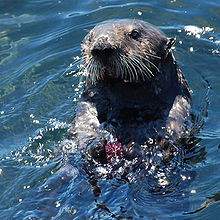
Then the day improved dramatically. Aside from my not dying, I saw a sea otter floating nearby. As I approached, he flipped off his back and stuck just his head out of the water, watching until I reached some invisible line at which point he dove underwater and resurfaced a short distance away.

Sea otters are the Spinal Tap of cuteness—eleven on a scale of one to ten. Bobbing on the water only a few dozen yards from the poster animal for adorable, I felt a tremendous sense of accomplishment. Braving the boats and the tides suddenly felt completely worthwhile. Doing things that frighten us doesn’t always pay off this well, but it often does. It’s helpful to remember that after the unpleasant, scary part, the universe might throw in some otters.

Roses Are More Than Red

When I need to escape at work, I go to the rose garden. It sits on the edge of an area where beautiful spots congregate. It seems a bit unfair that the spots don’t spread out, especially since they surround the College of Business, as if to show that money really can buy happiness.

Last time I was there, I saw a man with a hoe inspecting the flowers and thanked him for his work. Turns out he has been tending that part of campus for thirty years and created not only the rose garden but also the cactus garden across the lawn, not to mention a sheltered dirt path that always feels as if you’ve found a secret place none of the other 20,000 people on campus know about.

So did I ask this person who created one of my favorite spots what kind of connection he’d forged with the piece of earth he’d tended for thirty years? What it feels like to know a location so intimately? Why he decided to plant a rose garden? What his favorite flower is?

No. I don’t remember exactly what I said, but it resembled “Sure is warm today, isn’t it?”

I used to hate small talk. My answer to the weather question was “Yes.” This approach did not help me at parties. Then I realized that small talk isn’t evil and vacuous; it’s useful and vacuous. It puts many people at ease, and in a world where so many of us spend so much time wondering what we’re doing wrong, providing a little mind balm is not necessarily a bad idea.

But it’s a shame to make such a habit of it that when you meet the man responsible for a particularly beautiful corner of earth, you can’t get beyond thank you. I hope I get to see him again and get another chance to learn something real about this place and the person who cares for it. In the meantime, I am going to assume that his favorite rose is the same as mine, the orange and yellow one that somehow manages to bloom in at least three shades at once.

Vegetation Equals Inspiration

Here’s what I learned last week: trees are really, really cool. And important.

One of my favorite things about the local university is a series in which faculty members talk informally about books they’ve written. I attended the inaugural event for potential networking purposes and anticipated dull, dry, academic subject matter. Instead, I have been enthralled by Michigan farm houses, baseball in Taiwan, and urban trees of California, at least two of which are subjects I wouldn’t have touched with a twenty-foot pole, never mind a ten-foot one.

For a professor to find the time to write a book between teaching, grading, office hours, and multiple committee meetings, she must be passionate about the subject matter. I realized after the second talk that any time you put someone in a comfy chair, give her a cup of coffee, and invite her to have a conversation about what inspires her, you’re going to get something really good.

As with most things I learn, this is not news. Joseph Campbell’s “Follow your bliss” has been printed on everything from coffee cups to bumper stickers. Campbell has his own explanation of why to follow this advice. I think the reason is simple: because it’s one of the only ways to be infectious in a good way.

I like trees. I even consciously spend time with them, but if I wrote a book about the urban trees of California, or any trees for that matter, it would probably lack zest. The professor who gave the talk loves trees, delights in trees, knows the intimate details that make each one a unique source of wonder. His book inspires.

We don’t always get to spend as much time as we want doing the things we’re passionate about. Only a lucky few work for pay in their preferred area, and time gets consumed by life’s more mundane tasks. As a friend of mine says, “Adults do a lot of filing.” It’s also easy to get distracted, think our passion will not interest others, or simply forget the excitement of doing what we love because we don’t see that excitement modeled often enough.

If I, who fell asleep during the fourth inning at Wrigley Field, can be fascinated by baseball, your expression of your passion will capture someone, probably many someones. Practice it. We need more wonder in this world.

Note: In case you’re interested, the series is Cal Poly Authors.