Two Steps Back

If I were a space capsule, my re-entry from last weekend’s silent retreat at New Camaldoli Hermitage in Big Sur into the everyday would have included some layers being burned off in the atmosphere. This might have had something to do with my decision to give up protecting my heart as my Lenten practice.

On the last morning of the retreat, I was trying to be present as I ate breakfast, looking out at the fog that hid everything beyond my little garden, and worrying about this whole open heart thing. I looked down at the empty sugar packet I’d used for my tea and suddenly there was holy presence of sugar packet.

This was not an art deco sugar wrapper. This was your standard white with scrolly blue letters proclaiming, “Sugar, sugar, sugar.” It was a little rumpled and, in that moment, exactly as it ought to be, as if the essence of this particular sugar packet were shining through. This awareness lasted for a little while—holy presence of bowl, holy presence of plate. Then it faded, and we drove home.

I was determined to “keep faith with my newly awakened heart,” as Jim Finley says. Then I went to work Tuesday morning.

At my parish’s Advent retreat last year, Father Jim Clarke said that when you ask God for something, God rubs his/her hands together and says, “OK, let’s get down to this,” and shows you exactly how much you need to work on what you’ve requested. It was a normal Tuesday—I was late, work was busy, some things went according to plan, many did not. But by the end of the day, I was angry and impatient and had made snide comments about people I didn’t think were doing their job well, people who I had been practicing holding in my heart for months.

There are so many ways I protect my heart. Dwelling on others’ shortcomings and wrapping my own identity up in how well I do my job are only two. Worrying that people will like me and having imaginary conversations to convince people to see things my way also come to mind.

I don’t know how this is going to work. I never do at the beginning of Lent. But I still have the sugar packet and thirty-eight days—clearly enough time to complete a lifelong practice. Pray for me.
How to Die Like a Tree

During a walk with a friend this week, we saw a huge, dead tree lying on the ground, all in one piece with its base exposed. It looked as if it had toppled over gently at the end of a full life. My friend said he had heard that if you eat organic food, you die simply, easily, and all in a moment, like the tree. I said, “That’s what I’m aiming for.”

Then the meaning of my words echoed in my mind, and I was surprised that they didn’t completely freak me out. I have been thinking more about this whole death thing, perhaps because my parents are getting older, perhaps because I am.

I have another friend who I’m sure is going to leave this life exactly as that tree did—peacefully. He’s in his late eighties, recently had a stroke, and quickly made a full recovery. In an email he wrote afterward he said, “Mortality is real.”

I wonder how to live with a daily awareness of this fact. I don’t mean I want to cash in my retirement fund and travel to Iceland because tomorrow could be my last day, but rather how does one move in the world in a way that holds an awareness of our own transitory nature?

It might have something to do with not holding on so hard. To whatever—the way things are, the way we want them to be, the happy things, the sad things, the terrible, the wonderful. Not because they don’t matter but because they are passing.

Perhaps living with that awareness is like Buddhist monks building a mandala. They place each grain of sand with intent, attention, presence, and love until they’ve constructed an intricate, gorgeous piece of art and worship. They never hurry. Then they sweep it all away and pour the sand into a creek to be carried to the ocean.

The reason to construct the mandala is not the mandala’s future form because, ultimately, it doesn’t have one. The reason to construct the mandala is the act of constructing it. So the way to live today, given that one day we won’t be here, is with intent, attention, presence, and love toward what is happening today.

Gee, if it’s that simple, I should have it down by noon.

Camping with the Meister

What do leggings and a fourteenth century Dominican have to do with each other? Perhaps not much—unless you go camping with a Meister Eckhart sermon.

Those of you who follow the blog may have noticed I’m becoming an Eckhart fan. That’s because he says things like, “The everlasting and paternal wisdom saith, ‘Whoso heareth Me is not ashamed.’” Meaning, for me, that if you really hear the word of God—who may or may not be paternal for you—any sense of shame you have will evaporate because you hear your own divine nature.

It’s always fun when the universe gives you an immediate opportunity to practice what you think you learned. And by fun I mean deeply humiliating.

Later in the day, I went hiking and discovered I had not gotten the new deep woods fashion memo. With two or three exceptions, every other woman on the trail was wearing leggings. I was wearing bulky hiking pants that had sap on the butt to boot. So, yeah, instant shame.

But shame isn’t always easy to recognize. Especially when it presents itself as “Why are all these idiots wearing these stupid leggings? Don’t they know they’re in a state park not at yoga class?” That’s some pretty impressive and rapid externalization right there.

Luckily I was hiking really slowly, stopping to look at trees and ferns and such, so I heard myself thinking this a lot and realized that these were not happy thoughts. Don’t get me wrong—no instant enlightenment ensued. I internally commented on and hated, at least a little bit, every single pair of leggings, but I saw what I was doing most of the time and tried to let it go.

That recognizing and letting go often seems insufficient to me, but I’m gradually learning that it’s more than it seems. The next morning I woke up and actually saw the exact shape and color of the leaves on the trees in my campsite for the first time, the texture of their bark—what creation heard when God spoke those trees into existence.

Heart Cleaning

My dad and sister are coming to visit for Christmas, and there is this small matter of getting the house ready. There’s also a larger matter of getting my heart ready.

Readying the house requires making room for their physical presence—clearing the papers off the table so they have a place to eat, putting hangers in the closet for their clothes. We welcome guests by making space for them, by setting a place at the table.

One day I caught myself wishing that my dad and sister were arriving a few days later to give me more time to prepare. In other words, the whole reason for these preparations was to welcome them, and here I was wishing they’d stay away. That’s when the whole heart thing came up.

I think heart preparation is similar to home preparation. We need to clear some space in our hearts to welcome others into it. We have to let go of the preoccupations of how we want our lives to be—sometimes even when we think those preoccupations are in the service of others, like cleaning the house for their arrival.

We also have to let go of who we want them to be. I don’t mean that we should tolerate cruelty, but to truly love someone or something means loving her as she is—both the perfect and the imperfect bits. I think this is hard, especially with family members because so much of who we think we are is wrapped up in our relationships with them.

But what better time to practice than Christmas when we celebrate, to paraphrase Meister Eckhart, the birth of Christ in the essence and ground of our souls? When we make room for others in our hearts—relatives, friends, those who are struggling—we make room for this birth, and vice versa.

According to Eckhart, it’s worth the effort: “If you just wait for this birth to take place in you, you will find all that is good, all consolation, all bliss, all being and all truth.”


Note: The blog and I will be on vacation for the next two weeks. May whatever holy days you celebrate at this time of year bring you light, life, and love.

What Age Does

I have a number of wonderful student assistants at work. One of them was wishing the other day that we could do everything perfectly the first time—write bug-free code or a literary masterpiece in one pass—because life would be better that way.

I replied that it would be better if better meant getting more things done. He was surprised that I might think it meant something else. I said I used to agree with him but had recently begun to change my mind. He asked why, and I told him I thought getting older had done it.

He said, “Wow, age does that to people?”

It appears to have done it to me, but I wish it had done more complete job. I don’t believe accomplishment is the be all and end all, but I still measure my life and myself as if it were.

My unit of measurement is almost always tasks accomplished. I did a good job of the day if I got a lot done.

This produces a problem with benchmarking: what is a lot? What is enough? I know people who are far more efficient task completers than I am, so who do I reasonably include in the group to whom I compare myself?

Or maybe getting things done isn’t really my strong point; maybe I should measure myself on how loving or patient I was. So what is the rubric for loving? How do I score five out of five on that test?

Measurement is good for making cookies, but it’s not so great for making spiritual health—at least not at this time in my life. I end up in exactly the same state of mind whether I’m judging myself on the getting-stuff-done criteria or the loving criteria.

And I don’t want to be in a state of mind; I want to be in a state of heart. I’m not sure what that means yet, but it must include some fundamentally more spacious approach to self and others than judgment. It probably means no longer asking myself, “How do I do that?” because it probably has nothing to do with doing.

Hold, Carry, and Don’t Kill Anybody

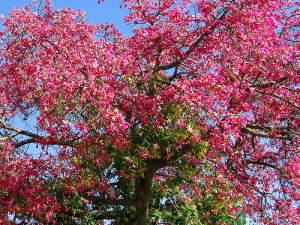
silk floss tree
A silk floss tree in bloom. Photo by Daniel Orth; used under Creative Commons attribution license.

Some days it’s possible to maintain an awareness that we’re really here to connect with that divine spark inside our fellow human beings and all of creation, to notice the miracle in the profoundly pink blossoms of a silk floss tree, to be kind, be kind, be kind. Some days, I might even see the value in loving my enemies. And other days, it’s all I can do to keep from throttling my friends.

I used to think the friend-almost-throttling days were a failure, but maybe not; maybe, for that day, they’re a tremendous success. After all, no strangulation occurred. Maybe grinding my teeth and doing nothing on the less enlightened days is as much a step toward loving my enemies as being kind is on the easier days.

Ronald Rolheiser said the first thing that ever made sense to me about Jesus on the cross, which is that he demonstrated how to hold, carry and transform whatever hurtful energy is directed at us. We are a mirroring species. If someone glances up to see a passing bird, we glance up, too. If someone likes us, we tend to like them, and if they dislike us, we usually return the favor.

So to really change anything rather than just reflect back what we get, we have to hold, carry and transform that energy. I don’t know why, but I think our capacity to do that is not the same every day. My conception of my best used to be that every day I would be the most efficient, disciplined and intelligent achiever of things that I could imagine. Now, I’m pretty sure that I’ll never reach what I can imagine, and I’m convinced that some days will be impressive and some will be of the not throttling variety.

But not throttling still contains an iota of holding, carrying and transforming, and it’s a lot better than the alternative.

Holy Expletives and Everything Else

Thursday surprised me. There are a lot of ways to be surprised by a day, I suppose. The one I experience most often is “Holy expletive, Thursday is over and I still have so much to do.” (Isn’t it nice that expletives can be holy? They remind me of Robin: “Holy Priceless Collection of Etruscan Snoods, Batman!”)

You could be surprised by the beauty of a day or the quietness of it or by something that happens during it, like a friend bringing you a giant hot fudge sundae for no reason at all. (This has not happened to me…yet; I like nuts on my sundaes if you ever get the inclination.) But I was surprised by the 6:13 p.m., October 9, 2014-ness of it.

I was driving past the In ‘n Out near my vanpool’s park and ride when an awareness arrived that this moment in time existed and I existed as part of it. It seems odd to be surprised that we exist, but I spend very little time in the here and now, which, as a lot of people have said before me, is the only place and time in which we do exist.

So when the here and now reached out and got in touch with me, it was different. It was also immediately and obviously the place I’d prefer to spend all my time because it was alive and beautiful and nothing was missing. For lack of a better word, I’d call it holy, no expletive necessary.

Perhaps the surprise came only after I lost contact with the present moment, which was approximately a nanosecond after it arrived. I started thinking, ooh, this would make a good blog post, thus catapulting myself several hours into an imagined future. But I remember that feeling of awareness, and I’m looking forward to our next meeting.

Note: This idea of presence is old and can be found in a lot of places. I want to give credit to my most recent encounter of it in someone else’s writing, which was a mention of John Duns Scotus’s term “thisness” in Richard Rohr’s daily meditation.

What Are the Odds?

I often choose to be annoyed by the tag line people attach to this or that online profile, but a few weeks ago, I saw one I liked: “Just to live is holy. Just to be is a blessing.”

A friend at work recently said that he often thinks about how huge the odds against his existence are. I once heard that if the timing at the Big Bang had been off by a trillionth of a second, particles would never have formed, much less stars, planets, and living beings. (This is one of those “I heard it somewhere” scientific facts rather than my usual “thoroughly researched on Google” scientific facts.)

He pointed out that you don’t have to get cosmic to be boggled by your good fortune. You only have to go a few branches back in your family tree because all of these people throughout history had to not only meet but also get together and feel frisky at an exact moment for your genome to come into existence. Not to mention all the twists and turns evolution didn’t take.

And then he said, “And what do we do with it? Play video games.” My internal response to this kind of reminder used to be, wow, I really need to change what I do. But trying to force myself to change my actions through guilt and mental chastisement has never really worked. The more effective question for me right now is “How do we do whatever we’re doing?”

If I could wake up every morning wildly grateful for and astonished by my existence, if I could maintain that reverence and wonder throughout the day whether I was doing dishes, working, or playing video games, I think my actions would change effortlessly, as a natural extension of my approach to life. If, with the psalmist, I could remember to sing, “I praise you, Lord, for I am wonderfully made,” I might start to do more of what I was made to do.

So Many Ways

It’s National Poetry Month! I know you’ve been waiting all year for the return of the Everybody Can Love Poetry Series. It has arrived.

For those of you who started following the blog more recently, last April I posted a couple of poems each week in hopes of convincing people that there are wonderful, meaningful poems that you can understand without a degree in English. Welcome to round two.

One of the wonderful things about poems is that they are beautiful, the way a piece of music or a painting or a sunset is beautiful. I walked to my neighborhood grocery store this week right after it had rained. One of the neighboring houses was surrounded by poppies, which always display their most gorgeous side in profusion. Another house sported a few well-trimmed, carefully placed flowering bushes, and I thought, there are so many ways to be beautiful.

I think about this sometimes when I look at my cat, who is quite handsome. We think cats with all different types of coloring are cute. Black and white cats, like Tux, can have four white paws or only a couple; their faces can be all black or a little white or half white with a big freckle on the tip of their nose, and their owners think they’re adorable regardless.

But sometimes we don’t extend the same generosity to ourselves. We face ourselves in the mirror and wish this or that looked otherwise. We look at how we’ve lived our lives and how others have lived theirs and find ourselves wanting, yet if we expected a poppy to look like a rose, we’d miss its beauty.

Here’s a poem from Mary Oliver that I think speaks to how we might recognize our own beauty.

The Buddha’s Last Instruction

“Make of yourself a light,”
said the Buddha,
before he died.
I think of this every morning
as the east begins
to tear off its many clouds
of darkness, to send up the first
signal — a white fan
streaked with pink and violet,
even green.
An old man, he lay down
between two sala trees,
and he might have said anything,
knowing it was his final hour.
The light burns upward,
it thickens and settles over the fields.
Around him, the villagers gathered
and stretched forward to listen.
Even before the sun itself
hangs, disattached, in the blue air,
I am touched everywhere
by its ocean of yellow waves.
No doubt he thought of everything
that had happened in his difficult life.
And then I feel the sun itself
as it blazes over the hills,
like a million flowers on fire —
clearly I’m not needed,
yet I feel myself turning
into something of inexplicable value.
Slowly, beneath the branches,
he raised his head.
He looked into the faces of that frightened crowd.

From: House of Light


Given to You

When you are at a religious education conference and someone at your hotel asks you to bring her a copy of the Lord’s Prayer, you really can’t refuse.

Last weekend, I attended the Los Angeles Religious Education Congress,  a wonderful celebration of everything that is alive and blossoming in the Catholic church. As our group was leaving the hotel one morning, a young woman in the room next to us opened the door and, catching sight of my name tag, asked if we were going to the conference. When I replied in the affirmative—you also really can’t lie—she asked me to bring her a copy of the Lord’s Prayer. She said she was Jewish and had never had a copy.

The whole conversation made me uncomfortable. I’m not big on converting people, and I don’t know many practicing Jews who are searching for the Lord’s Prayer. I hesitated, but she insisted.

So I said I would and proceeded to spend two hours walking around the exhibit hall searching for a printed version of said prayer. Lest you fear that the rise of Catholicism will bring about the demise of capitalism, let the exhibit hall at the largest religious education conference in the country put your mind at rest. Hundreds of booths offer everything from the kitschy to the sublime. I wandered past cards, candles, crosses of the metal, glass and wooden varieties, rosaries, priest’s vestments (one of my favorites because they are simply gorgeous, almost tapestries), countless spiritual books and Christian music recordings in English and Spanish, not to mention representatives from charities, universities, and every flavor of religious order.

In all this abundance, I found exactly one copy of the Lord’s Prayer with a horrible picture of a white, shiny Jesus on the back. I bought it for seventy-five cents. I left this and a Psalm 23 bookmark that a sympathetic Capuchin monk had given me in a bag on the woman’s door handle and went to my afternoon session, a music workshop.

In the music workshops you always receive a printed copy of the songs so you can sing along. On the last page of the handout was, of course, a new arrangement of the Lord’s Prayer.

When I knocked on the woman’s door that night, there was no answer, and so I still have the musical version of the prayer, along with a new understanding: If we are asked to give somebody the Lord’s Prayer—or anything else—it will be given to us.