Judgment Day Every Day

There’s nothing like a little loving kindness meditation to bring all your really nasty thoughts into sharp relief. I recently did a meditation that moves from offering loving kindness first to yourself—may I be happy, may I be well, may I find peace—then to someone you love, someone you feel neutral toward, and finally someone you don’t particularly like. Then I went out into the world and watched all these instant and cruel judgments about others flash through my mind.

For example, I was leaving church (seriously), and someone with what I considered to be an offensive bumper sticker cut me off on the way out of the parking lot. The thought that went through my head was at least as hateful as the bumper sticker.

I’ve known for a while that I am, to borrow a colleague’s phrase, a judging machine, but I don’t usually feel the spite attached to these thousand small opinions I form about others. Unfortunately, it is most certainly there.

The idea that world peace starts in our own hearts suddenly became very concrete. If I can condemn someone based on a bumper sticker—or the shoes they’re wearing or what I think I hear them whisper to their daughter in the pew in front of me—what are the odds that whole nations of people like me with the added difficulty of trying to bridge cultural differences are not going to kill each other to get resources?

There is a bright side, though: I saw those thoughts and knew they were thoughts, not truth. I can’t eradicate them, but I can continue to watch them and let them go. They won’t disappear, overnight, but with time, they may quiet down a bit.

If anything’s worth practicing, surely this is it. May you be happy. May you be well. May you find peace.
Birthing Love

This year I actually wanted to send Christmas cards (not to be confused with the actual sending of them). Every year, as people go their various ways for Christmas vacation, I find myself wanting to connect with all my friends before they leave, whether they’re close and I saw them last week or far and I haven’t seen or talked with them in months.

I’ve been wondering why the need to be together is so strong right now and why waiting until January feels like missing a critical moment. After all it’s only a couple of weeks. No other two-week period has that sense of urgency for me.

I think it’s because the Christmas spirit, which people of any or no religion can enjoy, comes alive when we notice love being born into the world. Love is always being born into the world, but we are impatient and easily distracted beings and often miss it. Luckily, we are also ritualistic beings, and so we build into our lives times to stop and pay attention. When an entire culture pauses and takes the time to celebrate that love, you can feel it.

And when you do, you might want to send Christmas cards or drop five bucks in the Salvation Army bucket or let someone go in front of you in line. Because we are the ones who birth love into the world. As with children or art or any other act of creation, it comes both from us and through us—we participate in its coming into being but are not its only source.

We tend and grow this love in our many relationships, and so of course, when love is in the air, there is an urge to reconnect. To all of you who will probably not, despite my best intentions, receive cards from me: I love you.

Note: The blog and I will be on vacation for the next two weeks. Wishing you all a merry Christmas and joyful new beginnings at the solstice and the turn of the year.

Momma Told Me

I don’t know why we’re designed to go two steps forward and one step back, but I’m convinced we are. Last week: Zen master. This week: whiner.

I exaggerate last week’s accomplishments, but I did have this miraculous moment of getting over myself. One of the software systems at work appears to have been designed to decrease productivity, and I generally spend a lot of time and energy hating it while using it.

This time a moment of spiritual brilliance flashed upon me. If I changed the goal from finishing the task to being present and paying attention, I could stop fighting the inefficient system because its inefficiency would no longer matter. So I changed the goal. My mind cleared up. My patience increased. My work probably improved, though I have no way to measure that.

Fast forward to this week. While working on another not favorite task, I said to myself, you could use this time as practice; where is your attention? I replied, somewhat snappishly, I don’t want to practice, I want to be miserable and complain. I clearly saw myself making that choice, but changing my approach still didn’t interest me. One step back—at least.

I kept this up most of the day and wore myself down sufficiently that, by the time I was chopping kale for dinner, I could consider the option of simply relaxing and accepting my sour disposition. Then this line from William Stafford’s poem “A Message from the Wanderer” came floating in: “Tell everyone just to remember/their names, and remind others, later, when we/ find each other.” Some days that’s all we can do, remember who we are, and that’s OK because that day is not eternal. The next day we’ll be capable of making different choices.

I’ll end with the rest of Stafford’s stanza because he sums it up so beautifully:

“…Tell the little ones
to cry and then go to sleep, curled up
where they can. And if any of us get lost,
if any of us cannot come all the way—
remember: there will come a time when
all we have said and all we have hoped
will be all right.”

Finding Faith

If you want to really effectively lose your car key, a stellar location to make the attempt is at the beach when the tide is coming in. Which of course is where I lost mine. Approximate odds of finding key in this situation: zero.

But of course I had to look. I’m not sure where that compulsion comes from, but I think it’s built into standard-model humans. I don’t know anyone who would leave the beach without searching.

I went one way and my friend went the other, and I thought, what the heck, I’ll ask St. Anthony (patron saint of finding things) and St. Jude (patron saint of lost causes, yes, seriously) for help.

I didn’t expect to find the key and knew that if it did, it would be due to great good fortune rather than any action on my part. Crediting my own finding skills amidst incoming tides and the shifting nature of sand would require some serious delusion. If my key and I were to be reunited, it had to happen because of something outside of me, but I still had my part to play. I had to walk a few miles, pay attention, and be open to the possibility of the key turning up. In other words, I had to practice faith.

I walked a couple of miles, paid attention, and maintained a steady attitude of non-expectant openness. OK, not really. I walked a half mile, forgot to pay attention, walked a little farther, started creating possible endings in  my head, remembered I was supposed to be non-expectant, got really tired of paying attention after about a mile, and attempted to not to completely give up hope for the second mile.

It felt a lot like meditation, and it felt as if this is what we are called to do. Show up, pay attention, be open to wondrous happenings but not expect particular results.

We didn’t find my keys. The run was not the triumphant, pre-race workout it was supposed to be, but the time at the beach was exactly the practice I needed.

There Is Enough

Here’s something to add to your list of things not to do: spend a week talking about God and art, fly home, go directly to the outlet mall. Not sanity inducing.

I spent last week at the Glen West Workshop in Santa Fe. I feel as if it reversed the spin of my subatomic particles—in a good way.

While searching for what might have shifted my perceptions, I realized that I spent so little time last week wanting things: wanting people to be different from who they are, wanting my life—or at least my income source and the state of my bathroom floor—to be different from what it is, wanting more dessert (OK, so there were eight flavors of self-serve ice cream, two of them chocolate, which was pretty magical).

We talked so little about discontent. We talked about poetry and writing habits and how to construct a play and where we were from and whether the worship service had gotten us to a prayerful place. And when we discussed difficult things, we focused on our experiences and what we might do next rather than assigning blame.

I do not think this happened because we were a gathering of saints who never speak ill of others in our daily lives. I think it happened because the Glen somehow managed to create an environment that says, there is enough: enough time, enough opportunity, enough talent, enough people who care, enough love. An environment that is the opposite of the one I found at the outlet malls.

Granted, it is easier to believe this when someone else is cooking your food and doing the dishes to boot, but I’m convinced that our everyday existence could be filled with so much more enoughness than it tends to be.

I don’t know how yet, but I intend to find out.

Love One Another

This week I was reminded that life pretty much boils down to one thing: love one another. I didn’t make this up. I heard it at church on Sunday.

The priest didn’t make it up, either. Jesus said it a few times. And he didn’t make it up—he learned it from the Jewish tradition. I don’t know all the world’s wisdom traditions backward and forward, but I’d be surprised if any of them didn’t at least mention this idea.

I don’t always remember to love, though, and even when I do, I don’t always practice it. It’s not a complicated teaching like algebra or a foreign language, which can be hard to learn and easy to forget. Yet I don’t spend the majority of my day thinking, “What would be the most loving thing to do in this situation?”

Or maybe “love one another” is hard to learn and easy to forget. Hard to learn because we’re taught that other things—wealth, success, physical beauty—matter more; easy to forget in the constant barrage of daily messages advertising any number of things that are supposed to make us feel loved, none of which include loving one another.

On top of that, there is this whole problem of being human. For reasons I don’t understand, we have a lot of fear and failings built in. No one had to make up greed and envy either, we do those unprompted.

But we also love unprompted and maybe we just need to practice more. It can be daunting if we start with the equivalent of the quadratic equation or irregular verbs, so we could take some guidance from David Roche, who leads the Church of 80% Sincerity. In the Church of 80% Sincerity, as Anne Lamott puts it, “everyone has come to understand that unconditional love is a reality, but with a shelf life of about eight to ten seconds.”

And miraculously, that is enough. The priest said one other thing: only love will change the world, not policies, not wars, not this cause or that one, only love. Amen.

Words to Live By

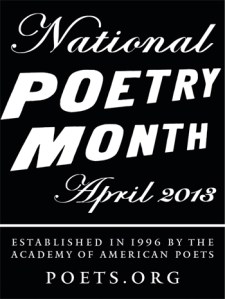
It’s National Poetry Month! Some of you may object to that exclamation mark and think that National Poetry Month is not far removed from National Root Canal Month, but I beg a couple paragraphs’ worth of your indulgence to convince you otherwise.

National Poetry Month April 2018, poets.orgSometime before we were taught that only English teachers can understand poetry, I believe that everyone loved poetry. “Humpty Dumpty,” after all, is a poem.

In grade school, poetry is often taught first as if it were mainly a question of counting syllables and later as if it were written in a different language. Shakespeare and Chaucer wrote some amazing verses, but here are the first two lines of the prologue to The Canterbury Tales:

Whan that aprill with his shoures soote
The droghte of march hath perced to the roote.

In the midst of your years of teenage angst, unless you were a future Middle English scholar, that might not have spoken to your soul. Imagine how different your relationship to poetry might be if, instead, you’d gotten a few lines of Mary Oliver’s “Wild Geese”:

You do not have to be good.
You do not have to walk on your knees
for a hundred miles through the desert, repenting.
You only have to let the soft animal of your body
love what it loves.

Poetry is as close as we get to saying the unsayable. It’s the language to use when you most desperately need to be understood, when your heart is broken seven different ways and in the middle you find either unending despair or astonishing hope, when the beauty of a rain drop on a blade of grass has taken your breath away or reminded you of your own mortality or both.

If you like music, you like poetry. If you like the psalms, you like poetry. If you like Paul Simon, you like hard poetry. Here are a few lines from “Obvious Child” whose meaning is far from obvious (punctuation is mine):

I’m accustomed to a smooth ride,
Or maybe I’m a dog who’s lost its bite.
I don’t expect to be treated like a fool no more.
I don’t expect to sleep through the night.

If I haven’t convinced you yet, give me a month. I’ll post a beautiful and accessible poem every few days in addition to the regular Tuesday night entries. Here’s one of my favorites to start:

The Magical Eraser
By Shel Silverstein

She wouldn’t believe
This pencil has
A magical eraser.
She said I was a silly moo,
She said I was a liar too,
She dared me prove that it was true,
And so what could I do—
I erased her!

Choosing Gratitude

One of my many talents is the ability to be dissatisfied in the midst of astonishing abundance. Case in point: last weekend’s retreat at the New Camaldoli Hermitage in Big Sur.

In years past, you called the hermitage for a reservation, and they assigned you a room. Now, with their new online reservation system, you choose your own room. That’s where the trouble began.

One of the first things I noticed on arriving was a tree partially blocking my view of the ocean. I started to picture how superior the views farther down the line must be and to wish I had chosen differently.

Allow me to clarify exactly how ridiculous this reaction was. The hermitage overlooks the Big Sur coastline, some of the most dramatic in the world. Every room opens onto a vista—in reality, you could see a tree when you looked at the ocean; it would have taken a forest to block the view.

Luckily, I heard myself being ridiculous and did not spend the weekend resenting that beautiful place. I did, however, begin to understand why monastics willingly give up many of their choices. When the rooms were assigned, I had never compared or judged them but had considered each one a great gift.

We often get caught up in evaluating our choices to ensure that we have the best rather than realizing that what we have is incredible. In another room, I wouldn’t have seen the quail rustling the rosemary bushes in the evening or the blazing red flowers of the New Zealand tea tree. I wouldn’t have heard the drone of bees—the loudest I can remember—coming from the giant pollen gathering festival taking place nearby.

I’m not suggesting we forfeit our choices. There are too many places in the world where people literally have no choice, and the resulting suffering can be immense.

I’m simply proposing that whichever road we choose, we remember it is strewn with gifts that are not better or worse, only different.

Good Things Come from Brooklyn

Father Tom Dentici, the priest who presided over my childhood, is one part dry humor, two parts conviction, and 100 percent Brooklyn-Italian. I think for him it might be one word, Brooklynitalian.

A snippet of conversation I recently overheard between Fr. Tom and a former parishioner:

Parishioner (excited, cheerful voice): “We’ll be thinking of you.”
Fr. Tom (deep, serious voice with a Brooklyn accent): “Don’t think of me. Pray for me.”
Parishioner: “I’ll tell my parents you’re doing fine.”
Fr. Tom: “Don’t tell them I’m doing fine. I’m not fine. Tell them I’m doing all right.”

At eighty-five, Fr. Tom now moves slowly with a cane, but mind and spirit are obviously still strong.

Fr. Tom preached the same thing every Sunday: God’s love. This was not butterflies and teddy bears love; this was serious love. He preached as if trying to speak forcefully enough to pry open our hearts and allow that love to rush in. Though he always stopped just short of, “You better let God love you or else,” you sometimes felt that’s where he was going, not because he wanted to proclaim punishment but because he believed that this was the most important thing in the world for our souls to understand.

In fourth grade I asked him about the fate of my Jewish mother’s soul, and in that same, grave Sunday-morning-sermon voice he said, “Your mother will go to heaven.” When I protested, pointing out that the New Testament said quite the opposite, he cut me off and repeated himself with such priestly authority that I couldn’t help but believe him. He saved God and Christianity for me that day.

At the same time, he had—and I assume still has—a wicked sense of humor. According to a visiting priest, he once pretended to be the voice of God when he saw a woman praying alone in a church. Though the story may have been apocryphal, no one in the congregation doubted he’d do it if given a chance.

One of my most enduring memories of Fr. Tom comes from the annual Octoberfest. In it, he is wearing a Hawaiian shirt and leading the congregation in the chicken dance, which is being played by a polka band.

Thank you, Tom Dentici, for your faith, your sincerity, and the love with which you shepherded your flock.

Feeling Monkish

Explaining monks is a little like explaining to someone who wasn’t a teenager in the 1980s why The Breakfast Club deserves a place in the respected canon of film. That is to say, you had to be there.

Nevertheless, because I recently spent two wonderfully peaceful days at St. Benedict’s Monastery in Snowmass, Colorado, I’ll make an attempt.

Monks are not saints and will be the first to tell you so. They are men who have chosen to dedicate themselves to a certain way of life. That sentence contains three difficult concepts: choice, dedication, and way of life.

Looking at what monks provide their guests may help with understanding those ideas; they give you exactly what you need and nothing more. One frying pan, a large saucepan, a small saucepan, a colander. Four each of cups, glasses, large plates, small plates.

No unnecessary choices are offered to distract you from the most important choice: to spend some time with God. Monks are like that—focused on what’s important.

That is not to say their minds don’t wander. The monastic days that I’m familiar with contain at least four communal prayer services precisely because monks know they need a lot of reminding.

They know they’re likely to get annoyed with the guy in the next cell because of the way he gargles or his ridiculous opinions about the way the church should be run, and they’ve accepted that those irritations only pull them away from their center. They’ve chosen what’s important to them and structured their lives around it in a way that takes their humanity into account.

The result is this amazing capacity for love. Love for each other, love for their visitors, love that flows out and fills the chapel and the entire valley.

I think we could all do this if we chose what was important to us and mustered up enough dedication to build a way of life around whatever we chose. It helps to have a few people around who will hold you to it.