Thank You

When I logged on last night, WordPress informed me that on that very date four years ago I started writing these reflections every week-ish. This is the kind of fact I wouldn’t have believed if a computer didn’t say it because four years is a long time.

Or it used to be. College was four years, and college lasted a long time, as I recall. As previously noted, this whole age thing alters either the space-time continuum or our perception of it. I know the latter is more likely, but I’m not ruling out the former.

Another reason it doesn’t feel as if it’s been a long time is you. Every time I wanted to spend the evening streaming an entire season of Arrested Development or scrolling through Facebook, I remembered that, miraculously, there are people on the other end of the ether who find this blog helpful.

Knowing that is humbling, in the truest sense of the word, that is, it reminds me that what happens here doesn’t so much come from me as through me but that I need to keep showing up. It keeps me honest, which means you keep me honest. You move me to look inside, beyond complaint, beyond self criticism (OK, usually) to say something I hope is useful. I have to give up my perfectionist streak and hit publish even on the days when I think, this is really not my best one. Almost every time, those posts receive the most likes and comments.

I saw a quote recently that said, “No one can do it for you, and you can’t get there alone.” That is absolutely true of this blog. Thank you.
What, Me Plan?

Planning is a strange thing—delusional and necessary at the same time. I recently spent a day at El Malpais National Monument in New Mexico. To quote the monument’s website, “The primeval black basalt terrain of El Malpais [which means the badlands] was created by volcanic forces over the past million years. Molten lava spread out over the high desert from dozens of eruptions to create cinder cones, shield volcanos, collapses, trenches, caves, and other eerie formations.”

Because the ground is solid rock, there’s no way to make a trail other than to mark it with cairns. As a directionally-challenged person, I felt somewhat unnerved heading out into this place where I was one cairn away from being lost. In reality, an always visible sandstone ridge indicated the direction of the road, but when I looked ahead and didn’t see the next cairn immediately, my mind started creating stories of being lost in the lava wilderness. “Unprepared hiker dies half mile from the road,” the headlines read.

The next cairn often wasn’t visible until I’d reached the one immediately preceding it. It reminded me of that E.L. Doctorow quote: “Writing is like driving at night in the fog. You can see only as far as your headlights, but you can make the whole trip that way.”

I think all of life is like this. We can plan all we want, but we usually can’t see the next cairn when we’re making the plan. The trail rarely follows the course we prescribe in advance.

But without a plan, without some sense of our eventual destination, we don’t know what direction to set out in, and we might not recognize our cairns along the way. We might even forget to look for them all together.

What Are the Odds?

I often choose to be annoyed by the tag line people attach to this or that online profile, but a few weeks ago, I saw one I liked: “Just to live is holy. Just to be is a blessing.”

A friend at work recently said that he often thinks about how huge the odds against his existence are. I once heard that if the timing at the Big Bang had been off by a trillionth of a second, particles would never have formed, much less stars, planets, and living beings. (This is one of those “I heard it somewhere” scientific facts rather than my usual “thoroughly researched on Google” scientific facts.)

He pointed out that you don’t have to get cosmic to be boggled by your good fortune. You only have to go a few branches back in your family tree because all of these people throughout history had to not only meet but also get together and feel frisky at an exact moment for your genome to come into existence. Not to mention all the twists and turns evolution didn’t take.

And then he said, “And what do we do with it? Play video games.” My internal response to this kind of reminder used to be, wow, I really need to change what I do. But trying to force myself to change my actions through guilt and mental chastisement has never really worked. The more effective question for me right now is “How do we do whatever we’re doing?”

If I could wake up every morning wildly grateful for and astonished by my existence, if I could maintain that reverence and wonder throughout the day whether I was doing dishes, working, or playing video games, I think my actions would change effortlessly, as a natural extension of my approach to life. If, with the psalmist, I could remember to sing, “I praise you, Lord, for I am wonderfully made,” I might start to do more of what I was made to do.

The Zen of Surfing

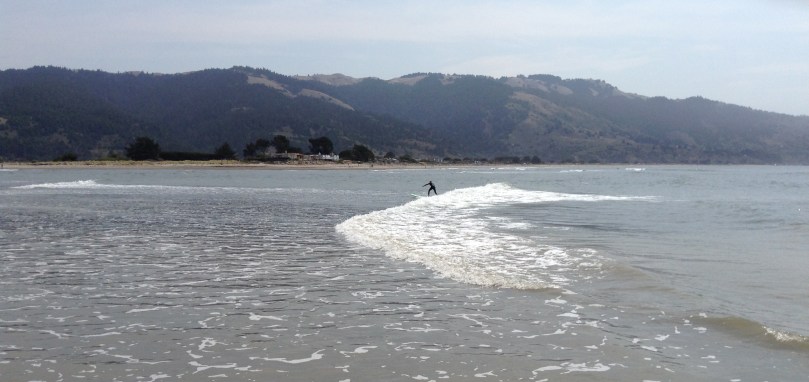
Some people become Zen masters after a slap upside the head. As befits a Californian, my uncle found enlightenment when we were learning to surf a couple of weeks ago. This was his insight: “The board doesn’t become more stable; you become more used to instability.” I confess to being skeptical at first, but the more I thought about it, the more sense it made.

Rachel surfing
Probably me on one of my more successful rides.

I spent most of the first day of lessons learning not to be alarmed that the board was rushing with all possible speed toward the shore. (A shout out to our excellent instructor, Nick, from 2 Mile Surf Shop in Bolinas, who pushed us into the waves, which was the only reason I was speeding toward shore.) In retrospect, alarmed was an interesting reaction because I hadn’t jumped out of a plane and I wasn’t headed toward a rock wall. The worst possible outcome ended with the board running into the sand. Still, it took a goodly number of waves before I believed the sand wasn’t going to hurt me.

The second day consisted of trying to get from my knees to my feet and failing—instability galore. It’s easy to understand the idea of keeping your feet in the middle of the board and a lot harder to do it.

On the third day came acceptance of instability, just as my uncle had said. I doubt my feet were much closer to the middle of the board than the previous day, but similar to overcoming my fear of running headlong into the menacing sand, I stopped freaking out as soon as the board wobbled. This had the miraculous effect of keeping the board from tipping over—at least not immediately—thus giving me more time to teeter back and forth and get my feet under me. I don’t think it was pretty, but I did stand all the way up and get off the board on purpose twice.

Riding the wobble is a lot like getting friendly with the “A” word—acceptance. If we stopped wishing for everything to be perfect and smooth, we might find that we can get a nice ride in whatever circumstances we find ourselves in. If you master that, let me know. I think I’m still on day two.

Minding Your Peas and Quinoa

When my brain gets really out of control with its negative messaging, sometimes I believe it and curl up in a ball and go to sleep. Other times, I remember that there are some things that help.

One thing that helps me is using these slightly adapted gathas (verses) from Thich Nhat Hanh as a mealtime prayer:

While serving food: In this food I see clearly the presence of the entire universe supporting my existence.

Looking at the filled plate: All living beings are struggling for life. May they all have enough food to eat today.

Just before eating: The plate is filled with food. I am aware that each morsel is the fruit of much hard work by those who produced it.

Beginning to eat: With the first taste, I promise to practice loving kindness. With the second, I promise to relieve the suffering of others. With the third, I promise to see others’ joy as my own. With the fourth, I promise to seek God’s peace. (The original says, “With the fourth, I promise to learn the way of non-attachment and equanimity”—I have a hard time with “non-attachment,” so I changed it.)

Finishing the Meal: The plate is empty. My hunger is satisfied. I vow to live for the benefit of all beings. (Thanks to The Endless Further for putting this online.)

I find that paying attention in this way quiets my mind for a few reasons. First, I have to slow down, at least for the first four bites. It’s hard to rush through a promise of loving kindness because it’s a rather large promise and always makes me gulp a little.

Second, these verses have a bunch of gratitude built into them, and it’s hard to think either that you’ve recently ruined the world or that the world is out to get you while recognizing how fortunate you are.

And third, this practice puts other thoughts in my brain. I usually mentally cross my fingers during “I promise to relieve the suffering of others,” the way you did when you were a kid and were promising to do something but knew you were lying. It seems such an onerous thing to promise. But tonight I thought, if I just worked on relieving my own suffering, other people wouldn’t have to deal with it, and that would probably do them a heap of good.

Thanks, Thich.

Running Against the Wind

Highly scientific claim of the week: you can only feel the wind when you’re moving against it—hurricanes, tornadoes and the like exempted.

Evidence Exhibit 1: When I went running up the canyon near campus this week, it was hot on the way out but breezy on the way back. The breeze could have started right at the moment I turned around, but I suspect not. Still, the situation may warrant further investigation, so—

Evidence Exhibit 2: When I lived in Chicago, a friend and I rode our bikes next to the lake. I finally learned that when I thought I was super speedy biker person, in reality a significant tailwind was giving me a boost. But I never physically felt it against my skin until I turned around and rode into it.

Conclusion: I think much of life is like this. We tend to notice the things that aren’t going our way more readily than the things that are. Personally, I prefer for everything to line up exactly the way I want it to—or I think that’s my preference. It’s never happened, so who knows how I’d actually react.

There’s a Chinese story that might explain why it hasn’t. A farmer’s horse ran away. All his neighbors said, “Oh, what terrible luck!” He said, “Maybe good, maybe bad.”

Then the horse came back leading an entire herd of horses right into his corral. His neighbors all said, “Oh, what good luck!” He said, “Maybe good, maybe bad.”

One day, his son was trying to break one of the wild horses, and he fell off and broke his leg. His neighbors all said, “Oh, what bad luck!” He said, “Maybe good, maybe bad.”

Then a war came, and his son was unable to fight because of his broken leg. I think you know what everyone said.

I don’t know why the direction I want to go can’t be the “maybe good” direction all the time, but I do know the breeze felt good on a hot day.

Completing Four Decades

Turning forty was the Big Event of my week (though Brazil’s poor performance in the World Cup semifinal gave it a run for the title of B.E.–what happened?!). Our forties might be the adolescence for our second half of life—we’re not yet considered old but certainly can no longer claim to be young.

I’m fascinated by how simply aging gives us a new perspective without our having to work at it, a concept that didn’t occur to me in my twenties and early thirties. I’ve noticed a few contributing factors.

There is, of course, the physical side. I had the good fortune to spend some time with a friend’s two-year-old recently. I still enjoy climbing on jungle gyms and blowing bubbles, but the pulled calf muscle that’s been hanging on for months was easily be tweaked by a race across the playground—a race with a two-year-old, remember.

As I’ve aged, my relationship to time has changed. Ten or fifteen years in the future is now imaginable. As recently as a few years ago, I knew I would probably exist in ten years, but I couldn’t hold onto any idea of myself or my life that far away. Now, my friends and I wonder whether we will still own our houses when our fifteen year mortgages are paid off. The prospect is terrifying but comprehensible.

I am also occasionally more at ease within my life. I feel as if I am just beginning to see that much of what I worry about isn’t worth worrying about but am not yet old enough to actually stop worrying about it. I suspect this comes from failing and realizing that the world didn’t cease to exist, though I am still too often convinced that it will after my next horrific mistake.

All this makes it easy for me to understand why people go out and buy sportscars in their middle age. Because what we use to define ourselves—the goals, the accomplishments, the roles we play—and their meanings get a bit slippery. Sports cars are solid.

I get the sense, though, that if I can stick with the slipperiness, something interesting is waiting around the bend. I’ll keep you posted.

Lessons from Hardwood

With apologies for more time away than anticipated, here’s a recap of what the universe of wood flooring taught me this past month.

Lesson the first: Cardboard is a wood floor’s best friend.

Lesson the second: As a friend said, yay for dads.

Empty room with wood floor
The new wood floor in all its glory.

Lesson the third: I liked seeing my floor stripped down to the plywood, though I’m still not sure why. Maybe it’s reassuring to know there’s something under it all. Maybe the unpretentiousness of plywood—its simplicity—appeals to me. The plywood, paint-splattered as it is, appears to be comfortable with itself and its role in the universe, a state of being I often fail to achieve.

Lesson the fourth: Home improvements are worth it. Every time I walk into my bedroom and see the floor, I think to myself, “Wow, this is my room” because I’m that surprised by how beautiful it is.

Lesson the fifth: Do-it-yourself projects provide an excellent opportunity to practice the spirituality of imperfection (not my term, stolen from Richard Rohr). The first time you use leveling compound, it’s not going to be pretty.

Lesson the sixth: Beds are awesome. I slept on a cot in the living room for more than a week and the return to my bed was, as previously stated, awesome. I think Tux, my cat, was happier than I was.

Lesson the seventh: Though unanticipated moments may lead to quality time contemplating different shades of brown caulk, they may also form the happiest memories. One of my favorite moments had nothing to do with the floors. Dad and I were leaving for dinner, and Tux had snuck out into the patio. I was attempting to lure him in with treats, and he, being a cat, was determined to remain uninterested. Then my dad—who usually addresses Tux with, “Yes, cat, out of the way”—said, “Go on Tuxer. She has some treats for you.” Anything is possible.

Open Up the Door

In case you didn’t know, The Beatles were really, really smart. They summed up what I learned this week:

When I was younger so much younger than today
I never needed anybody’s help in any way
But now these days are gone, I’m not so self assured
Now I find I’ve changed my mind and opened up the doors

Last weekend, I was staring at a pallet full of wood flooring held together with two impressive steel bands. Over the phone, my dad recommended using a Sawzall to cut them because I didn’t have a tin snips. I had used a Sawzall before, so it was no longer in the category of scary power tool. But then he said, “You might want to put on some safety glasses if you have them.” At that moment, it became very relevant to my life that my neighbor’s garage door was open.

I had watched my neighbors build a bunk bed frame and so concluded that they probably owned many tools, including, perhaps, a tin snips, a tool that does not require safety glasses. I wandered into the garage and after calling some hellos met not my neighbor but a friend of theirs who lived around the corner.

There were no tin snips, but this young man knew all about Sawzalls. He could tell a blade designed to cut metal from one that cut wood in a single glance. He quickly noted that the metal blade I had inserted was old and dull and therefore might fly apart mid-cut. And then he volunteered to do the sawing for me. I said yes.

I’m happy to report that no shrapnel flew, no one was rushed to the emergency room. I’m even happier to report that a few minutes later, the young man came back to borrow some aluminum foil for barbecueing corn and stayed for a few minutes to ask me about my water softener.

It struck me that it took such a small letting go of self-assurance “open up the door,” to transform our relationship from “people who live next to each other” to “neighbors.” I spend a lot of time trying to convince myself and others that I can do it on my own, but The Beatles have it right: Help!


Note: The blog may be sacrificed to the home improvement gods the next couple of weeks as my dad and I install the above-mentioned flooring. If you know of any other sacrifices that appease these particular gods, please don’t hesitate to perform them on our behalf.

Comfort Food

I don’t know about you, but I needed a Julie Andrews moment today:

Raindrops on roses and whiskers on kittens
Bright copper kettles and warm woolen mittens
Brown paper packages tied up with strings
These are a few of my favorite things.

I know we had a moment a few weeks back with the apple strudel, but today I was thinking about comfort; we turn to these very concrete things when we need comforting. Personally I go for hot chocolate or homemade macaroni and cheese.

This is what baby blankets and favorite sweatshirts are all about. It is why we get on airplanes we will complain about later and travel thousands of miles to visit friends and family. It is the magic that printed books and hand-written letters still hold. It is the reason my purring cat was not immediately booted off my lap when he started to bat at me while I typed.

I don’t know anyone who, when the world is weighing heavily, prefers a philosophy book to a cup of tea with a friend. I hope even those who have known suffering and grief I can’t imagine or understand can touch things that comfort them.

And yet my relationship to the physical is often one of obligation or control. I tell myself, sternly, to eat four servings of vegetables a day (rarely happens) or to water the plants so I don’t feel guilty about killing them. It would be so much more life-giving—to me and the plants—to spend a little time admiring how beautiful they are or to be aware for a few breaths that I am so connected to them that I am breathing in what they recently breathed out.

My most joyful moments arise when I am physically present with other people or with nature, so why not trust that? Please pass the brownies.