Words to Live By

It’s National Poetry Month! Some of you may object to that exclamation mark and think that National Poetry Month is not far removed from National Root Canal Month, but I beg a couple paragraphs’ worth of your indulgence to convince you otherwise.
National Poetry Month April 2018, poets.orgSometime before we were taught that only English teachers can understand poetry, I believe that everyone loved poetry. “Humpty Dumpty,” after all, is a poem.

In grade school, poetry is often taught first as if it were mainly a question of counting syllables and later as if it were written in a different language. Shakespeare and Chaucer wrote some amazing verses, but here are the first two lines of the prologue to The Canterbury Tales:

Whan that aprill with his shoures soote
The droghte of march hath perced to the roote.

In the midst of your years of teenage angst, unless you were a future Middle English scholar, that might not have spoken to your soul. Imagine how different your relationship to poetry might be if, instead, you’d gotten a few lines of Mary Oliver’s “Wild Geese”:

You do not have to be good.
You do not have to walk on your knees
for a hundred miles through the desert, repenting.
You only have to let the soft animal of your body
love what it loves.

Poetry is as close as we get to saying the unsayable. It’s the language to use when you most desperately need to be understood, when your heart is broken seven different ways and in the middle you find either unending despair or astonishing hope, when the beauty of a rain drop on a blade of grass has taken your breath away or reminded you of your own mortality or both.

If you like music, you like poetry. If you like the psalms, you like poetry. If you like Paul Simon, you like hard poetry. Here are a few lines from “Obvious Child” whose meaning is far from obvious (punctuation is mine):

I’m accustomed to a smooth ride,
Or maybe I’m a dog who’s lost its bite.
I don’t expect to be treated like a fool no more.
I don’t expect to sleep through the night.

If I haven’t convinced you yet, give me a month. I’ll post a beautiful and accessible poem every few days in addition to the regular Tuesday night entries. Here’s one of my favorites to start:

The Magical Eraser
By Shel Silverstein

She wouldn’t believe
This pencil has
A magical eraser.
She said I was a silly moo,
She said I was a liar too,
She dared me prove that it was true,
And so what could I do—
I erased her!

Choosing Gratitude

One of my many talents is the ability to be dissatisfied in the midst of astonishing abundance. Case in point: last weekend’s retreat at the New Camaldoli Hermitage in Big Sur.

In years past, you called the hermitage for a reservation, and they assigned you a room. Now, with their new online reservation system, you choose your own room. That’s where the trouble began.

One of the first things I noticed on arriving was a tree partially blocking my view of the ocean. I started to picture how superior the views farther down the line must be and to wish I had chosen differently.

Allow me to clarify exactly how ridiculous this reaction was. The hermitage overlooks the Big Sur coastline, some of the most dramatic in the world. Every room opens onto a vista—in reality, you could see a tree when you looked at the ocean; it would have taken a forest to block the view.

Luckily, I heard myself being ridiculous and did not spend the weekend resenting that beautiful place. I did, however, begin to understand why monastics willingly give up many of their choices. When the rooms were assigned, I had never compared or judged them but had considered each one a great gift.

We often get caught up in evaluating our choices to ensure that we have the best rather than realizing that what we have is incredible. In another room, I wouldn’t have seen the quail rustling the rosemary bushes in the evening or the blazing red flowers of the New Zealand tea tree. I wouldn’t have heard the drone of bees—the loudest I can remember—coming from the giant pollen gathering festival taking place nearby.

I’m not suggesting we forfeit our choices. There are too many places in the world where people literally have no choice, and the resulting suffering can be immense.

I’m simply proposing that whichever road we choose, we remember it is strewn with gifts that are not better or worse, only different.

Good Things Come from Brooklyn

Father Tom Dentici, the priest who presided over my childhood, is one part dry humor, two parts conviction, and 100 percent Brooklyn-Italian. I think for him it might be one word, Brooklynitalian.

A snippet of conversation I recently overheard between Fr. Tom and a former parishioner:

Parishioner (excited, cheerful voice): “We’ll be thinking of you.”
Fr. Tom (deep, serious voice with a Brooklyn accent): “Don’t think of me. Pray for me.”
Parishioner: “I’ll tell my parents you’re doing fine.”
Fr. Tom: “Don’t tell them I’m doing fine. I’m not fine. Tell them I’m doing all right.”

At eighty-five, Fr. Tom now moves slowly with a cane, but mind and spirit are obviously still strong.

Fr. Tom preached the same thing every Sunday: God’s love. This was not butterflies and teddy bears love; this was serious love. He preached as if trying to speak forcefully enough to pry open our hearts and allow that love to rush in. Though he always stopped just short of, “You better let God love you or else,” you sometimes felt that’s where he was going, not because he wanted to proclaim punishment but because he believed that this was the most important thing in the world for our souls to understand.

In fourth grade I asked him about the fate of my Jewish mother’s soul, and in that same, grave Sunday-morning-sermon voice he said, “Your mother will go to heaven.” When I protested, pointing out that the New Testament said quite the opposite, he cut me off and repeated himself with such priestly authority that I couldn’t help but believe him. He saved God and Christianity for me that day.

At the same time, he had—and I assume still has—a wicked sense of humor. According to a visiting priest, he once pretended to be the voice of God when he saw a woman praying alone in a church. Though the story may have been apocryphal, no one in the congregation doubted he’d do it if given a chance.

One of my most enduring memories of Fr. Tom comes from the annual Octoberfest. In it, he is wearing a Hawaiian shirt and leading the congregation in the chicken dance, which is being played by a polka band.

Thank you, Tom Dentici, for your faith, your sincerity, and the love with which you shepherded your flock.

What Lasts

It is scary to be old enough to have had a 20-year high school reunion. On the other hand, it is amazing to be old enough to gather with former school friends all of whom are capable of recognizing and celebrating the various ways we’ve become adults.

During winter carnival weekend, a small group of friends from junior high and high school gathered to watch street events and reconnect with Steamboat and with each other. People in the group have done impressive things—become doctors or engineers, sold everything and started over with a new lifestyle that fit better, given birth. Perhaps most impressive to me was that we all still enjoyed each other.

Some of these people I see annually and some I hadn’t seen for over twenty years, but we still laughed and told stories not as if time hadn’t passed but rather with a miraculous ease in spite of being aware that it had.

The idea that the friendships we make before age 25 are more lasting than those we make later in life has come up in conversation recently. I doubt this is uniformly true, but I think there’s something to it.

Things enter us differently when we’re children than when we’re adults—landscape, music, language; so many things go straight into our DNA, so to speak, unquestioned and unfiltered by the layers of judgment we practice as adults. Perhaps this is true for childhood friendships, too—they get wired in somehow.

It’s nice to know that even when our daily thinking and acting is overlaid with adult concerns, we can rediscover the connections we formed when life was more immediate. And see what good choices our younger selves made.

I Like It Here

When I was growing up, the promotional video for my hometown of Steamboat Springs, Colorado, featured a bunch of guys sporting Magnum P.I. mustaches sitting in a hot tub singing, “Steamboat, Steamboat, I like it here.” Though the video has been updated several times since then, I still agree with the lyrics.

horse pulling a child on skis down a street in front of a crowd
Ski joring down Lincoln Avenue in Steamboat. Photo courtesy of Jonathan Boeke.

Steamboat recently celebrated its 100th Winter Carnival, and I attended along with my family and a number of friends from high school. Here are a few of the reasons why it was so much fun.

One: carnival buttons, which get you into all the weekend events and are often seen pinned to ski hats, still cost only $10. I bought mine off a woman on the bus who had an extra.

Two: the carnival is a liability nightmare. Put skis on small children, give them a rope to hold, tie the other end of the rope to a horse and tell the rider to go as fast as possible down a street covered in a couple feet of snow. Just for fun, add a jump in the middle. Or start with a 50 meter ski jump. Wait until dark. Add a flaming hoop and have people jump through it. Just for fun, let one of them pull a toboggan that is on fire.

Three: though the population of the town has more than doubled since I was a kid (to a whopping 12,000), everyone still puts on four layers of clothing and stands around in the snow for six hours cheering for the kids and the horses. Occasionally a kid lets go of the rope before she crosses the finish line and then has to ski half a block or so on her own. Everyone cheers the loudest for these kids, and every single kid who let go of the rope crossed the finish line even though she knew she wouldn’t win.

Four: nowhere else in the world will you see a rugby team, a refrigerator, and a running gas grill on skis. There was sauerkraut for the hotdogs.

Five: keeping the local ranchers at the center of the festivities as riders and parade participants somehow ties the different parts of the community together in a way that doesn’t happen in many places.

Six: the lighted man. Yes, he is shooting fireworks out of his backpack. Yes, it is the coolest thing ever.

Plan to buy your buttons for the 101st.

Feeling Monkish

Explaining monks is a little like explaining to someone who wasn’t a teenager in the 1980s why The Breakfast Club deserves a place in the respected canon of film. That is to say, you had to be there.

Nevertheless, because I recently spent two wonderfully peaceful days at St. Benedict’s Monastery in Snowmass, Colorado, I’ll make an attempt.

Monks are not saints and will be the first to tell you so. They are men who have chosen to dedicate themselves to a certain way of life. That sentence contains three difficult concepts: choice, dedication, and way of life.

Looking at what monks provide their guests may help with understanding those ideas; they give you exactly what you need and nothing more. One frying pan, a large saucepan, a small saucepan, a colander. Four each of cups, glasses, large plates, small plates.

No unnecessary choices are offered to distract you from the most important choice: to spend some time with God. Monks are like that—focused on what’s important.

That is not to say their minds don’t wander. The monastic days that I’m familiar with contain at least four communal prayer services precisely because monks know they need a lot of reminding.

They know they’re likely to get annoyed with the guy in the next cell because of the way he gargles or his ridiculous opinions about the way the church should be run, and they’ve accepted that those irritations only pull them away from their center. They’ve chosen what’s important to them and structured their lives around it in a way that takes their humanity into account.

The result is this amazing capacity for love. Love for each other, love for their visitors, love that flows out and fills the chapel and the entire valley.

I think we could all do this if we chose what was important to us and mustered up enough dedication to build a way of life around whatever we chose. It helps to have a few people around who will hold you to it.

Where’s There?

Having an obsession and fulfilling that obsession are two very different things. I’ve been getting ready to go on vacation, which generally sends me into an OCD quest of trying to tie up every possible loose end between 10 p.m. and midnight the night before I leave.

Given the lack of tied-up-ness in my daily life and the late hour at which I start, I usually stay up until I am forced to give up. At this point, I feel a surprising amount of peace.

A friend said in the comments last week that when she’s focused on the future, she gets frustrated that she’s not there yet. I only feel that way approximately 99.8% of the time. I think that’s what’s nice about getting ready to leave: it’s a defined, immutable “there.” The plane will leave at 6:27 a.m. whether you’ve watered the plants or not.

It’s interesting that it’s not so much the getting everything done before leaving as the simple existence of a cut-off point that brings that peaceful feeling. I perceive the “there yet” that I torture myself with as having to do with lack of accomplishment, whether tangible or interior, but this experience suggests otherwise.

It suggests that the ever-changing nature of the finish line causes more anxiety than what’s happening in the actual race. If every moment could be its own finish line, I wouldn’t have to worry about this whole journey thing.

Checking in on Reality

When you are chronically single, it is good to have at least one other chronically single friend. This increases the odds that, at any given time, one of you will be sane.

I was speaking with one such friend recently, and it was her turn to be sane. Both of us would like to have kids, and both of us are ever more rapidly approaching the age of ain’t gonna happen. The subject came up and my friend said in a hushed, semi-awed voice, “I think I’m OK with that.”

The “OK with it” option had occurred to me but was a little too scary to contemplate closely, like the ingredients list of a Twinkie. I have this idea that thinking will make it so, but here’s the thing: it is already so—I neither have kids nor do I currently find myself in a situation that leads to the rapid production of children.

When do we continue to believe in the possibility of something that isn’t yet and when do we accept life in its current state? On the never ending list of things I don’t understand, the balance between those two is near the top.

My friend’s sanity lay in shifting the emphasis: while she may not have this one thing she wants, she recognizes that her life is incredible. The question is not so much am I giving up on something as am I remembering that right now, my life is incalculably rich. Right now, I have an enjoyable job; I live in a beautiful place; all the parts of my body work well; I have wonderful friends and family; I no longer need to worry about the ingredients list of a Twinkie.

Louis CK does a great comedy routine called “Everything’s Amazing and Nobody’s Happy.” (On being impatient with smartphones: “Give it a second, it’s going to space.”) There’s always something available with which to play the if only game—marriage, kids, publication, four-foot-high chocolate fountain. It’s just so much more fun to play the everything’s amazing game.

Not So Little Anymore

I declare this week Little Sister Appreciation Week because my little sister is awesome. In both the really great and fills-me-with-awe meanings of the word.

My sister is six years younger than I, so every time she hits a milestone—driving, college graduation, thirty—it reminds me how old I am. But to make up for that, she amazes me with who she has become. Recently, I keep realizing that she has become a grownup.

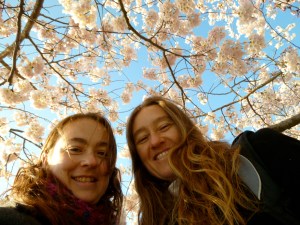
The author and her sister under a blooming cherry tree
My sister, me, and some cherry blossoms.

Her most recent demonstration of grownup-ness consisted of caring for my dad after hip surgery. My dad is a lot of wonderful things, but he’s generally unresponsive to people telling him what to do. If they could measure stubbornness, I feel certain he would be in the Guinness Book of World Records. He also resists cleaning even more than I do, which is a strong statement to make.

My mom had a couple of surgeries a few years ago, and even though I mostly showed up at the hospital and smiled, I was pretty much of a train wreck. My sister, on the other hand, had to figure out house cleaning, buying new furniture, modifying a walker, cooking two weeks’ worth of meals to freeze, and coaching Dad through his first physical therapy sessions. And she is deaf.

Deafness gives you a whole new way of experiencing the world; it also makes parts of life more difficult because most of our institutions, services, and processes are designed for hearing people—hospitals and furniture stores, for example. Yet she navigated all this expertly. Color me amazed once again.

Just for fun, here are a few of the many other reasons my sister is awesome:

  • She is a talented artist.
  • She makes me laugh so hard I can’t breathe.
  • She celebrates her deafness.
  • She is always learning more about her profession.
  • She has impeccable taste.
  • She tells it like is.
  • I can’t think of anything that makes me happier than seeing her when one of us has just gotten off an airplane.

Thanks, Little Sis, for being you.

Bring on the Beauty

I just received in the mail my first in a long time ridiculously expensive relative to my income bracket purchase, perhaps the first ever that is not a bicycle. It’s way too nerdy and grown up of an item for such an event, but I’ve been staring at my new “upcycled wooden desk trays,” vintage distressed French country style, and feeling really happy ever since I opened the package. Perhaps nothing I’ve bought in my life has come with so many adjectives attached.

wooden desk trays labeled "in" and "out" with scrabble tiles
Upcycled wooden desk trays from Vintage Chichibean on Etsy

Let me express my appreciation for the word “upcycled.” I am generally not a fan of creating words unless you can do it as well as Roald Dahl, but upcycled is a brilliant marketing word, appealing to people’s vanity and environmental consciousness all at once.

I admire not only the description but also the physical presence of my desk trays. I like the size and shape of them, the heft, the way they’re cleverly slotted together. I like the unevenness of the paint and the yellow-green color that is more attractive than yellow-green has any business being.

The way buying new stuff can make us happy used to worry me. I have a complicated relationship with the physical, which I suspect I share with many Americans. On one hand, we are deluged with marketing telling us that our appearance matters more than anything else, and on the other, we hold onto our Puritan forebearers’ attitude that physical things are not particularly worthy or holy and possibly downright sinful.

But we are physical beings, and we are drawn to and enlivened by beauty of various types, many of which we experience through our senses. Few would argue that a painting by Rembrandt or Monet is shallow because its beauty is physical.

I’m not saying I’m going to sprinkle holy water on my desk trays (that would be blessed vintage distressed French country style), but I welcome them both for the enjoyment they’re already bringing me and for the reminder that beauty comes in many forms, and we need them all.