Minding Your Peas and Quinoa

When my brain gets really out of control with its negative messaging, sometimes I believe it and curl up in a ball and go to sleep. Other times, I remember that there are some things that help.

One thing that helps me is using these slightly adapted gathas (verses) from Thich Nhat Hanh as a mealtime prayer:

While serving food: In this food I see clearly the presence of the entire universe supporting my existence.

Looking at the filled plate: All living beings are struggling for life. May they all have enough food to eat today.

Just before eating: The plate is filled with food. I am aware that each morsel is the fruit of much hard work by those who produced it.

Beginning to eat: With the first taste, I promise to practice loving kindness. With the second, I promise to relieve the suffering of others. With the third, I promise to see others’ joy as my own. With the fourth, I promise to seek God’s peace. (The original says, “With the fourth, I promise to learn the way of non-attachment and equanimity”—I have a hard time with “non-attachment,” so I changed it.)

Finishing the Meal: The plate is empty. My hunger is satisfied. I vow to live for the benefit of all beings. (Thanks to The Endless Further for putting this online.)

I find that paying attention in this way quiets my mind for a few reasons. First, I have to slow down, at least for the first four bites. It’s hard to rush through a promise of loving kindness because it’s a rather large promise and always makes me gulp a little.

Second, these verses have a bunch of gratitude built into them, and it’s hard to think either that you’ve recently ruined the world or that the world is out to get you while recognizing how fortunate you are.

And third, this practice puts other thoughts in my brain. I usually mentally cross my fingers during “I promise to relieve the suffering of others,” the way you did when you were a kid and were promising to do something but knew you were lying. It seems such an onerous thing to promise. But tonight I thought, if I just worked on relieving my own suffering, other people wouldn’t have to deal with it, and that would probably do them a heap of good.

Thanks, Thich.

Giving Thanks

Here’s something to aspire to: “For all that has been, thank you. For all that is to come, yes” (Dag Hammarskjöld, second United Nations Secretary-General and Nobel Peace Prize recipient). I’m not there yet, but this holiday is good practice.

This year’s selection from the cornucopia of things that make me grateful I’m alive:

Cake batter—and cookie batter and icing of course and the way all of the above cling to the insides of bowls and the edges of beaters demanding that we lick them off.

Cats—because when looked at rationally they are an odd choice for a companion but when looked at non-rationally they are cute and funny and cuddly, at least when they’re not attacking you. Plus they purr. You really can’t beat purring; that was evolutionary genius.

People who make things by hand—weavers, woodworkers, drywall hangers, bread bakers, especially those amazing folk who can take scraps of this and that and presto, there’s a table or a fancy dress.

Home—a sense of belonging, a feeling of safety and peace, an awareness of being loved.

Monastics—monks and nuns of all religions, lay people who are exceptionally contemplative, everyone who holds that sacred space in the midst of daily life. They are doing it for the rest of us.

Camping—all types, car, backpacking, anything that involves sleeping on the ground, frying your toast in a pan, waking up to the smell of pine trees and going to bed having just been reminded of how vast the Milky Way is.

Moments—the ones that take my breath away, the ones filled with laughter, the peaceful ones, the silent ones, the shared ones.

Friends and family—without whom, none of the above would be as fun or loving or wonderful.

Happy Thanksgiving, everyone.

In Praise of Leftovers

Last week I enjoyed a large bounty of one of those simple wonders of modern living: leftovers. They are often unappreciated and sometimes even maligned, but I think whoever invented leftovers was brilliant.

Maybe leftovers got a bad rap back in the day when humans were killing wooly mammoths and the tribe ate the same meal for months at a time. That whole lack of refrigeration problem meant that each day the remaining mammoth meat tasted a little worse or else you had to go through the effort of drying and salting and, let’s be honest, it was a bit tough after that.

But now, leftovers are brilliant. Here are just a few good things about them.

Thing #1: You don’t have to cook. Or dry and salt. I like to cook, but I also like not cooking every day. It’s a treat to have a little extra time to accomplish something worthwhile, like checking Facebook.

Thing #2: You don’t have to figure out what to cook.

Thing #3: Leftovers are kind of like loaves and fishes. If you put some into a separate Tupperware, you suddenly have a whole other meal called lunch.

Thing #4: They taste good—usually.

Thing #5: They are free. OK, not really, but they are already paid for as opposed to almost any other option available on nights when you don’t want to cook.

Thing #6: You don’t have to cook. Did I mention this already?

Thing #7: You can freeze them and then you don’t have to cook some other day. You can even freeze them in individual containers and eat them now and again rather than five days in a row. Or so I hear. I have never been organized enough to take advantage of this particular benefit.

Reading this list might lead you to believe that the essence of what makes leftovers fabulous is that you can be lazy. That might be true. Let’s make it Thing #8.

Being Together

My apologies for missing the blog post unannounced last week, but I have a great excuse: I was visiting some longtime friends, which reminded me how life-giving it is simply to be together.

A couple of these friends I met in college, and I often forget how well they know me. When you live with someone for two or three years, you see every side of them—the kind, the impatient, the elated, the dejected. It’s rather miraculous that we’ve hung onto these friendships for more than half our lives because in that many years, we are all bound to do more than one something that pisses the other person off.

The remarkable thing is that spending time together is more important than the particular activity. Whether eating rhubarb pound cake at the up-and-coming restaurant in town or hamburgers at home on an overcast Memorial Day, playing with the toddler or meeting the cats and touring the new condo, the company made the moment. The rest of it was fun but secondary.

I don’t know why this is true, but I know it is. I’ll probably always remember certain moments listening to live music, watching theater, or eating great food, but I don’t think any of them will enter as deeply or mean as much as sitting with these friends and wondering about nearing midlife or catching each other up on daily happenings or not talking at all.

I think we’ve all done a good job of valuing our friendship throughout the years, but it seems that the older we get, the more deeply we understand just how lucky/fortunate/blessed we are.

Maybe love, like wine or cheese, can improve with age. And like the wine in its oak barrel or the cheese in its cave, it does so by simply being in the presence of those we love and appreciating who they are.

In Praise of Flowers

An incredible row of bearded irises in more than the colors of the rainbow is blooming along the path between the van drop off and my office. Every day my vanmates and I walk by them, we comment on their beauty. Every day, there’s a new facet to notice, a new color opening up to the world. It must be the best way to start the day.

purple irises

A few amazing things about flowers:

Amazing thing number one: irises come in more than one color—burgundy, a purple so deep you can almost taste it, combination packs of dusty red or violet with yellow, a bloom that starts off the palest purple and turns white as it unfurls.

Amazing thing number two: the whole furling business. These large petals start out all folded up in a neat little package. How do they do that?

Amazing thing number three: this is only one kind of flower! We have yet to celebrate the bright orange poppies along the side of the road or the jasmine whose scent is filling my patio with honeyed air or the delicate cherry blossoms that look just as beautiful falling off the tree as in full bloom.

Amazing thing number four: you don’t have to do anything except plant and water them. You don’t have to cajole them or pay them or promise them fame. It’s just what they do.

Amazing thing number five: flowers use their beauty to help support all land-dwelling life. Without flowers, we would be in big trouble.

The richness of these fifty feet of ruffled, life-giving color is too great to comprehend.

In keeping with the National Poetry Month theme, here is a poem about what comes after the flowers.

From Blossoms
By Li-Young Lee

From blossoms comes
this brown paper bag of peaches
we bought from the boy
at the bend in the road where we turned toward
signs painted Peaches.

From laden boughs, from hands,
from sweet fellowship in the bins,
comes nectar at the roadside, succulent
peaches we devour, dusty skin and all,
comes the familiar dust of summer, dust we eat.

O, to take what we love inside,
to carry within us an orchard, to eat
not only the skin, but the shade,
not only the sugar, but the days, to hold
the fruit in our hands, adore it, then bite into
the round jubilance of peach.

There are days we live
as if death were nowhere
in the background; from joy
to joy to joy, from wing to wing,
from blossom to blossom to
impossible blossom, to sweet impossible blossom.

Choosing Gratitude

One of my many talents is the ability to be dissatisfied in the midst of astonishing abundance. Case in point: last weekend’s retreat at the New Camaldoli Hermitage in Big Sur.

In years past, you called the hermitage for a reservation, and they assigned you a room. Now, with their new online reservation system, you choose your own room. That’s where the trouble began.

One of the first things I noticed on arriving was a tree partially blocking my view of the ocean. I started to picture how superior the views farther down the line must be and to wish I had chosen differently.

Allow me to clarify exactly how ridiculous this reaction was. The hermitage overlooks the Big Sur coastline, some of the most dramatic in the world. Every room opens onto a vista—in reality, you could see a tree when you looked at the ocean; it would have taken a forest to block the view.

Luckily, I heard myself being ridiculous and did not spend the weekend resenting that beautiful place. I did, however, begin to understand why monastics willingly give up many of their choices. When the rooms were assigned, I had never compared or judged them but had considered each one a great gift.

We often get caught up in evaluating our choices to ensure that we have the best rather than realizing that what we have is incredible. In another room, I wouldn’t have seen the quail rustling the rosemary bushes in the evening or the blazing red flowers of the New Zealand tea tree. I wouldn’t have heard the drone of bees—the loudest I can remember—coming from the giant pollen gathering festival taking place nearby.

I’m not suggesting we forfeit our choices. There are too many places in the world where people literally have no choice, and the resulting suffering can be immense.

I’m simply proposing that whichever road we choose, we remember it is strewn with gifts that are not better or worse, only different.

Good Things Come from Brooklyn

Father Tom Dentici, the priest who presided over my childhood, is one part dry humor, two parts conviction, and 100 percent Brooklyn-Italian. I think for him it might be one word, Brooklynitalian.

A snippet of conversation I recently overheard between Fr. Tom and a former parishioner:

Parishioner (excited, cheerful voice): “We’ll be thinking of you.”
Fr. Tom (deep, serious voice with a Brooklyn accent): “Don’t think of me. Pray for me.”
Parishioner: “I’ll tell my parents you’re doing fine.”
Fr. Tom: “Don’t tell them I’m doing fine. I’m not fine. Tell them I’m doing all right.”

At eighty-five, Fr. Tom now moves slowly with a cane, but mind and spirit are obviously still strong.

Fr. Tom preached the same thing every Sunday: God’s love. This was not butterflies and teddy bears love; this was serious love. He preached as if trying to speak forcefully enough to pry open our hearts and allow that love to rush in. Though he always stopped just short of, “You better let God love you or else,” you sometimes felt that’s where he was going, not because he wanted to proclaim punishment but because he believed that this was the most important thing in the world for our souls to understand.

In fourth grade I asked him about the fate of my Jewish mother’s soul, and in that same, grave Sunday-morning-sermon voice he said, “Your mother will go to heaven.” When I protested, pointing out that the New Testament said quite the opposite, he cut me off and repeated himself with such priestly authority that I couldn’t help but believe him. He saved God and Christianity for me that day.

At the same time, he had—and I assume still has—a wicked sense of humor. According to a visiting priest, he once pretended to be the voice of God when he saw a woman praying alone in a church. Though the story may have been apocryphal, no one in the congregation doubted he’d do it if given a chance.

One of my most enduring memories of Fr. Tom comes from the annual Octoberfest. In it, he is wearing a Hawaiian shirt and leading the congregation in the chicken dance, which is being played by a polka band.

Thank you, Tom Dentici, for your faith, your sincerity, and the love with which you shepherded your flock.

Checking in on Reality

When you are chronically single, it is good to have at least one other chronically single friend. This increases the odds that, at any given time, one of you will be sane.

I was speaking with one such friend recently, and it was her turn to be sane. Both of us would like to have kids, and both of us are ever more rapidly approaching the age of ain’t gonna happen. The subject came up and my friend said in a hushed, semi-awed voice, “I think I’m OK with that.”

The “OK with it” option had occurred to me but was a little too scary to contemplate closely, like the ingredients list of a Twinkie. I have this idea that thinking will make it so, but here’s the thing: it is already so—I neither have kids nor do I currently find myself in a situation that leads to the rapid production of children.

When do we continue to believe in the possibility of something that isn’t yet and when do we accept life in its current state? On the never ending list of things I don’t understand, the balance between those two is near the top.

My friend’s sanity lay in shifting the emphasis: while she may not have this one thing she wants, she recognizes that her life is incredible. The question is not so much am I giving up on something as am I remembering that right now, my life is incalculably rich. Right now, I have an enjoyable job; I live in a beautiful place; all the parts of my body work well; I have wonderful friends and family; I no longer need to worry about the ingredients list of a Twinkie.

Louis CK does a great comedy routine called “Everything’s Amazing and Nobody’s Happy.” (On being impatient with smartphones: “Give it a second, it’s going to space.”) There’s always something available with which to play the if only game—marriage, kids, publication, four-foot-high chocolate fountain. It’s just so much more fun to play the everything’s amazing game.

Not So Little Anymore

I declare this week Little Sister Appreciation Week because my little sister is awesome. In both the really great and fills-me-with-awe meanings of the word.

My sister is six years younger than I, so every time she hits a milestone—driving, college graduation, thirty—it reminds me how old I am. But to make up for that, she amazes me with who she has become. Recently, I keep realizing that she has become a grownup.

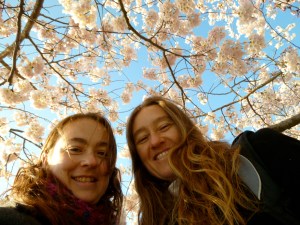
The author and her sister under a blooming cherry tree
My sister, me, and some cherry blossoms.

Her most recent demonstration of grownup-ness consisted of caring for my dad after hip surgery. My dad is a lot of wonderful things, but he’s generally unresponsive to people telling him what to do. If they could measure stubbornness, I feel certain he would be in the Guinness Book of World Records. He also resists cleaning even more than I do, which is a strong statement to make.

My mom had a couple of surgeries a few years ago, and even though I mostly showed up at the hospital and smiled, I was pretty much of a train wreck. My sister, on the other hand, had to figure out house cleaning, buying new furniture, modifying a walker, cooking two weeks’ worth of meals to freeze, and coaching Dad through his first physical therapy sessions. And she is deaf.

Deafness gives you a whole new way of experiencing the world; it also makes parts of life more difficult because most of our institutions, services, and processes are designed for hearing people—hospitals and furniture stores, for example. Yet she navigated all this expertly. Color me amazed once again.

Just for fun, here are a few of the many other reasons my sister is awesome:

  • She is a talented artist.
  • She makes me laugh so hard I can’t breathe.
  • She celebrates her deafness.
  • She is always learning more about her profession.
  • She has impeccable taste.
  • She tells it like is.
  • I can’t think of anything that makes me happier than seeing her when one of us has just gotten off an airplane.

Thanks, Little Sis, for being you.

Falling into Place

I bribed my family to forego skiing in Colorado and come to California for Christmas. The winning offer: Dungeness crab at $6.99/lb.

We’ve never before gathered in California, and the four of us haven’t been together in quite a few years. When reflecting on what made the week so much fun, it appeared to me that we’re all at a point where we want to be with each other or are at least capable of enjoying the company. With the possible exception of the cat, who made it clear he objected to the disruption of his usual routine.

It’s not always easy to remember that things happen in stages. My sister is six years younger than I, and for years I didn’t want her around. In my late teens and early twenties, I didn’t want any of my family members around. By the time I returned to the fold, my sister had had about enough of all of us. The two of us have been close for years now, but it took some time.

The cycle turned again this year, and it felt as if things I didn’t even know were missing fell into place a little.

That’s not to say we’re perfect. My sister and I had to stop speaking about a photograph because we disagreed so strongly about its contents. My parents are divorced, and though they did us the gigantic favor of not hating each other, they are not those people you see in the movies who remain close friends.

Yet we all seem to have come to a place where, most of the time, we don’t need each other to be any more or less than who we are. The other side of the coin, I think, is that we all have some acceptance of our own failings. We can, mostly, listen to stories about ourselves and say, wow, did I really do that? A gentler reaction than, I did not do that!

The future undoubtedly holds anger and frustration along with the joy and love, but this Christmas felt like a healing, as if something was sewn together that will make our relationships stronger in the future. And that is a remarkable gift.