Simple Is Good

The great thing about French is that it makes even the most ordinary things sound fancy. I cooked ratatouille for the first time tonight and discovered that it is not at all fancy.

I think ratatouille must once have meant, “I’m tired from screaming at the kids and milking the goat and cleaning the house all day. I don’t know what to make for dinner, so I’m going to roast whatever vegetables are ready to pick with some olive oil, garlic, and, hm, the rosemary bush needs trimming so I’ll throw in a couple branches.”

To make this dish, you cut vegetables in big pieces, toss them in some olive oil and salt, throw the pan in the oven, and end up with a rather delicious dinner (at least if you follow the recipe in the wonderful cookbook Cook This Now by Melissa Clark). Not delicious in the “my mouth is turning somersaults trying to figure out what this unique flavor combination is” but delicious in its simplicity.

Simple things bring us back to ourselves, snatch us off our hamster wheel of thoughts about past mistakes and future pressures and say to us, “Here, try putting your feet on the ground. It is a little easier that way.” Some people may feel most relaxed wearing an evening gown and dining on duck a l’orange, but I suspect for most of us it’s macaroni and cheese and our favorite sweats.

Our daily lives demand a lot of being on—on top of things, on the ball, on target. Stews, soups, and sweatpants, on the other hand, offer comfort without demanding a lot of skill or attention. You don’t have to impress the chicken and dumplings; they love you already. And your chicken and dumplings don’t have to impress whoever’s eating them; those people already love chicken and dumplings.

After dinner, the cat curled up in my lap, and we lounged until a moth appeared who needed to be chased. I think the Quakers had it right: ‘tis a gift to be simple.
Not to Clean

Labor Day is not usually life-changing for me, but this year, I learned something extremely important: cleaning takes time. Others may have grasped this concept much earlier in life, but I’m pretty excited about it.

Let me unfold the revelation for you. I played soccer all day Saturday. On Sunday, a friend and I went to an art show and then some other friends had me over for dinner. Monday morning I looked disconsolately around my house and wondered how another weekend had gone by without any scrubbing, vacuuming, or mopping taking place. No hope beckoned as most of the coming day was slotted for eating pancakes, giving my dad a birthday call, buying groceries, and hanging out with my mom.

Then, while describing my weekend to my dad, divine inspiration descended: I realized I could have cleaned only if I had done it instead of all those fun things. True, this is a bit like mastering a kindergarten-level mathematical concept while doing your Ph.D., but I had never accepted the either-or idea in this context before.

I always felt as if it should be possible to do it all—the fun stuff and the cleaning—as if everybody else knew some secret technique. But no, they were actually spending time with sponge in hand. That’s the problem with this whole finite thing, every moment can contain only one action, no matter what we like to think about multitasking.

I have a quote from Mastercard above my desk at work. It says, “Not having to choose—priceless.” It’s there to remind me that the people who say I can have it all are selling me something and that the freedom to choose is a great gift.

So if I have to decide between a soccer tournament and a clean bathroom, the bathroom will lose every time. And I’m OK with that now. Mostly.

Creeping Contentment

Last Saturday I had a few moments of not wanting my life to be any different. And even worse, I was not at all scared of this clearly unreasonable contentment.

You might be saying to yourself, but why is this unreasonable? Your life is pretty darn good. Yes, actually, it is, but popular thought in my brain holds that if you say that above a whisper, the complacency monster will jump out and gobble you up.

Though a few weeks back I proposed observing my life to see whether anything was truly running amuck, I didn’t really intend to do that for more than a couple of days. Any longer and this whole acceptance thing could get way out of hand.

Then obligation and discipline both took a long vacation. Two people I told about this said, “Oh, it’s summer,” dismissing any need for continuous improvement for at least another month.

So I floated around for a couple of weeks, not trying to increase my holiness quotient, reduce my impact on the environment, clean, or win a Nobel Prize. In other words doing what I usually do but with much less guilt.

Come Saturday I had succumbed to such an extent that I thought, wow, I like this. Even my usual “you will become an eternal couch potato of contentment” thoughts seemed inconsequential and possibly unlikely.

Couch potato fear does have reinforcements. The next attack goes something like, but you haven’t achieved everything you said you wanted to and since you are not a) actively pursuing it or b) feeling like you should be actively pursuing it, you are screwed.

I suppose this may be true. It may also be true that enjoying where you are helps you get where you want to be. But don’t tell anyone I said so.

Laugh Until It Hurts

Silliness apparently runs in my family. My mom, sister, and I traveled to San Diego last week. The most enjoyable part of our trip was neither the feats of marine mammals at Sea World nor the amazing Afghani food we ate, well, devoured (at Chopahn if anyone’s San Diego bound). The best moments had more to do with hobbits.

I don’t remember what inspired the first Golem impression of the trip, but that one inspired many others. They all had us laughing in that way that makes everyone around you in the restaurant either very envious or very nervous. The kind of laughter that makes you cry, the kind where you look at each other, not really sure why or whether the cause is hilarious enough to merit this reaction but nonetheless grateful for how good it feels.

This laughter differs from that invoked by even the funniest movie or most clever comedy routine. It has a refreshing quality, like dipping your soul in a mountain spring. No one would choose the Henry women over Robin Williams for a night of entertainment, yet when each of us curled her lips, rolled her eyes back in her head, and located her throatiest voice, we were, at least to ourselves, the funniest act around.

I suspect we could all use more of this breath-taking fun. I wish I could bottle it or write a recipe: mix three parts friends or family with two parts shared experience; add a day of relaxation and three drams silliness; mix.

The magic seems to arrive when it will, though, and the unexpectedness of finding yourself struggling for oxygen and wondering whether your abs will be sore the next day only makes the moment that much more precious.

Giving In

Have you ever had a day when every attempt at productivity forced you to the bottom of an ocean of frozen molasses? My mom and I call that a 20% day. Don’t fight the 20% days. They are Muhammed Ali or Mike Tyson, and you are a featherweight.

The term 20% days comes from Anne Lamott’s book Plan B. In one of her essays, she tells the story of David Roche, who leads the Church of 80% Sincerity. He preaches that eighty percent of the time, we can strive to improve ourselves or attempt other noble actions, but 20% of the time, nobility will likely escape us. And that is OK.

Telltale signs of a 20% day:

  • Approximately nothing can inspire you to get out of bed, and you are not sick.
  • After you manage to get up and have breakfast (serious bonus points for anything beyond cold cereal or toast), putting your dirty dishes in the dishwasher requires herculean effort.
  • When you try to convince yourself you can achieve any of the tasks on your list, your head threatens to explode.

Solution:

  • As soon as you feel your head reaching exothermic potential, desist all thoughts of productivity. It is really, really helpful when 20% days arrive on the weekend.

As you may have guessed by now, I had a 20% day recently. It took me half an hour of lying in bed to recognize it and another 15 minutes to remember the bit about Mike Tyson. Fighting is tempting because it feels as if you will never find the motivation to get out of bed, but if you wait, the time will arrive.

I got up and made breakfast (bonus points for me!) and forgot again that resistance is futile. So I sat in my chair after breakfast feeling as if I should do something. Then I remembered to concede to the inevitable and spent more time in my chair not feeling as if I should do something.

That was my breakthrough moment: 20% days do not have to suck. If you don’t try to produce Nobel Prize winning research or clean behind the stove, they can be remarkably pleasant, somewhat foggy and definitely not productive, but pleasant.

And remember, 20% is one in every five days. If you’re basically functional for a week straight, you’re an overachiever.

Hold Still

You might think that after thirty-two years of playing soccer, enjoying it would no longer surprise me. But I strive not to be that sensible.

Driving home from a game the other night I thought, “That was fun.” The thought is not new, but this time I paused long enough to let it expand into some open space in my brain, space that is usually occupied by other, less fun thoughts, such as, how can I exercise more, write more, eat more vegetables, and have more down time? In my next life I want to worry about why I can’t do less, just for variety.

Quality improvement processes go like this: look at what’s happening, see which part is broken, figure out a possible solution, try it, check to see whether it’s working. My brain, on the other hand, goes like this: assume nothing is as good as it could be, come up with twenty-five hours worth of daily improvements, begin system overload due to attempted expansion of space-time continuum, scramble to scale back and prioritize, fail, shut down system, reboot and run again. I am pretty sure I found this method in the Tao Te Ching or Bhagavad Gita.

That momentary space in my brain allowed me to wonder whether anything actually needs to be improved. Might it be possible that I am healthy enough, accomplishing enough, treating others well enough? And if so, what do I do about it?

Because it only took a few minutes to realize that everything being OK is pretty scary. What happens next if we’re OK? What is there for us to DO? How can we prove our worth? What will prevent us from sitting on the couch eating potato chips to the exclusion of all else?

Age-old wisdom aside, I think I’ll risk living my life exactly the way it is for a few months and check to see whether, just maybe, everything’s OK.

Of Otters, Kayaks and Mortality

When I go sea kayaking with my dad, I spend a good amount of time thinking I am going to die. Never mind that he refuses to take me anywhere except protected bays.

Dad once told me a story of some unfortunate couple in a small craft getting creamed by a tanker. I translated this to all boats with motors simultaneously will not notice and are gunning for all small, oar or paddle-driven boats. If you think those psychos in their outboard-powered death machines cannot both ignore and aim for something at the same time, you are not using your imagination (see post on fretting).

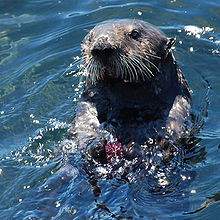
sea otterThis time, however, another threat presented itself. We were heading out toward the breakwater, that is, more than 100 yards from shore. Though still protected, it appeared that we would come close enough to the open ocean that it would insist on pulling me out to a watery grave.

A boat did, of course, try to run me over on the way out, by which I mean, I paddled in front of it while it was close enough to be visible. After this near-death encounter, Dad instructed me to stay away from the towering, foot-high breakers with the apparently clear-to-him instructions, “Don’t go where they are.” Breakers tend to separate me from my kayak.

Then the day improved dramatically. Aside from my not dying, I saw a sea otter floating nearby. As I approached, he flipped off his back and stuck just his head out of the water, watching until I reached some invisible line at which point he dove underwater and resurfaced a short distance away.

Sea otters are the Spinal Tap of cuteness—eleven on a scale of one to ten. Bobbing on the water only a few dozen yards from the poster animal for adorable, I felt a tremendous sense of accomplishment. Braving the boats and the tides suddenly felt completely worthwhile. Doing things that frighten us doesn’t always pay off this well, but it often does. It’s helpful to remember that after the unpleasant, scary part, the universe might throw in some otters.

The Fretting Gene

Someday, they will isolate the gene for worrying. At that time, a great quandary will face the human race: should it be genetically engineered in or out?

Arguments against the gene:

  1. The medical community seems to believe that stress is not good for you, and I have yet to encounter worry without stress.
  2. Worrying is not particularly enjoyable.
  3. The Visit wrapped up last Thursday morning. It was, by all measures, a stunning success (she said humbly). On Saturday, I dreamt that I’d failed to plan a way for our visitors—who you will remember had gone home two days earlier—to get to Easter mass. Apparently my ability to produce anxiety can overcome both the separation of church and state and the space-time continuum.

Arguments for the gene:

  1. One non-worrying friend claims that only worriers can write novels because writers have to imagine horrible things happening to their characters. When I caught myself thinking that some student research posters might get stolen out of the back seat of my car at Office Max, I decided there might be something to this theory. I had to tell myself sternly that no one nearby wanted to know about albino quail enough to break into my car.
  2. Another friend who doesn’t worry told me multiple times over the last month, “Don’t fret.” What American would even remember such a fine word as “fret” if she didn’t have someone telling her not to do it? This argument is only applicable if you know someone British.

Calm and peaceful friend number one also contends that whether or not you think up every possible calamity, you end up in approximately the same place. That is the problem with non-worriers—they lack the imagination to recognize that the rest of us are holding the world together. So those of you who think things just work out should thank the rest of us for saving you from the hordes of giant, rabid, albino quail.