Seek and, Well, Just Seek

It is so easy to get distracted in this life, and let’s be honest, there are some fantastic distractions, like Agents of Shield or a European bakery window full of tasty delights. Most often for me, though, it’s the inside of my own head.

My brain has been obsessed with the doing end of things recently, and I don’t know about yours, but my brain can be very convincing. I’ve been walking around for several weeks acting as if the voice in my head were describing reality.

I was talking with a monk once who said that his focus for the year was to let God love him. He was probably in his mid fifties at the time—it’s hard to tell with monks—so he’d been doing this pretty intense God thing for at least twenty years and apparently still hadn’t mastered it.

That is reality. That is what doingness mind distracts me from with its promises of fulfillment if only I can cross all the items off the list on time. Never mind that new tasks continually pop onto the bottom of the list, appearing out of the ether with no effort on my part.

Perhaps it is not surprising that we approach life this way. Our educational system is more or less structured this way and so are our jobs. And to some extent so are we. Human beings seem to be internally propelled forward. We choose—or perhaps are attracted to—different directions, but most of us are seeking something most of the time.

While we are certainly capable of wandering off in the wrong direction, maybe the bigger problem arises when, unlike that monk, we become convinced that we can find whatever it is we’re looking for.
Allowing Mystery

Richard Rohr, among others, says we live our lives three steps forward and two steps back. One of my big do-si-dos is forward to allowing and back to control. As you may have guessed, the last week or two have not been forward steps.

Among other really clever and subtle methods of control—such as interrupting people to show them I’ve already figured out what they’re going to say—I returned to confusing my to-do list with my life, or perhaps more accurately my self. Because everyone knows that if you can figure out, keep track of, and do everything that needs to be done—and do it well of course—then you are a good, worthy, and fulfilled person. You might even be qualified to run the universe.

Thich Nhat Hanh, in his book The Heart of the Buddha’s Teaching, recommends aimlessness instead of striving. “There is nothing to do, nothing to realize, no program, no agenda….Your purpose is to be yourself.” It reminds me of the Tao Te Ching’s “When nothing is done, nothing is left undone.”

I don’t think either of them is encouraging my reluctance to wash the dishes. Rather, they’re suggesting letting life unfold according to its plan rather than ours. My to-do list is my plan, and while it’s certainly useful, when I forget that it’s a tool and assign it self-worth-measuring-meaning-of-life status, things go downhill fast.

The more life-giving not-plan is to allow ourselves to be brought into existence, to allow the divine to express what it has in its heart as it continually loves us into being. When I focus all my energy on getting stuff done, it’s as if I’m hoping these things I do will create me, but there’s no room to become anything wider or deeper than I already am, no room for mystery.

Mystery is both what we are and what we are living, what we come from and what we are becoming. We need a good deal of aimlessness to stay in touch with that.

I’m Here

There are some things you just can’t ignore. Last week I was driving to Vespers at the Monastery of the Risen Christ, and I was late, a typical state of being for me. You might think we late types stroll along with great aplomb, but usually, I worry and try to mentally hurl myself through time and space to somehow arrive earlier. Surprisingly, this approach has not actually worked yet, despite trying so hard I feel an internal pushing force.

As I neared the monastery, a group of vultures caught my attention and drew my eye to the meadow, at which point I had to stop the car in the middle of the empty road: a bald eagle flew low above the grass, quite close by, with prey in his talons.

In thirteen years, I’ve never seen a bald eagle on the Central Coast of California, and had I been on time, I’d have missed it. I know just enough about Native American spirituality to know that if you have the good fortune to receive a message from Eagle, the Divine really wants to get your attention. This message was unmistakable: I’m here.

I’m here when you’re running late and when you’re on time, when you’re messing up and when you’re succeeding. You can’t actually screw this up because I’m here regardless, and you can’t fix it for the same reason—I’m here so there’s nothing to fix.

There is perhaps no message I’ve resisted more strongly until now. How, you may ask, as I have, can this be true for the victim of a drive-by shooting or children caught in a war zone? I have no answer for that, and at the same time, this experience gave me a deep certainty that this here-ness is true.

It keeps popping up this week, or maybe more accurately breaking through. As I try to finish this presentation at work and everything else slips farther and farther behind: I’m here. As I fail again and again to live from my heart: I’m here. As I notice the flowers on the trees: I’m here. I’m here with you and inside you and with and inside everything else. I’m here.

Not Getting There

This week may have been about not losing sight of the infinite, which of course I learned by losing sight of it in many small ways. Like eating three—OK four, but they were small—croissants in one day, panicking over approaching work deadlines, or falling back into my default position of resisting doing things such as the dishes or writing this blog. But somewhere in the midst of that, I heard for the first time the phrase, “the peace that surpasses all understanding.”

Of course I’ve known those words most of my life, but I’d never heard them, especially that word “surpasses.” I’d always heard, “There’s this state out there that you’re supposed to achieve that you don’t understand yet because you’re not advanced enough, pure enough, whatever you’re supposed to be enough.” Turns out this is not what “surpasses” means. Plus there’s that pesky little “all” in there.

This peace is not understandable ever, no matter how smart you are or how holy you are; your mind cannot grasp it. I don’t know about your mind, but mine is not fond of admitting the existence of things outside its purview.

Jim Finley says something along the lines of, we think there’s a corner to turn and then we’ll be able to grasp all this, but there isn’t. That’s the story our mind tells, but as Finley points out, there’s nowhere to get to because “all this” is infinite.

On first blush, I am not a fan of this situation because I really want to get to that un-gettable place. I want to believe that at some point in my life I will have better time management skills, and that will make it all OK. But on second glance, there’s a spaciousness that opens up when I admit the possibility that, as William Stafford says, “there will come a time when all we have said and all we have hoped will be all right.” That time is any moment we choose to accept existence, including ourselves, as it is.

Note: The Stafford quote is from the poem “A Message from the Wanderer.” “The peace that surpasses all understanding” is from Philippians 4:7.

Everywhere You Look

Here is what I learned last week: we absolutely must let God love us because it is the only way to help others see that God loves them. Or if you are not into God, we must allow ourselves to experience that the core of our being is divine—essential, complete, creative, unconditional, fully connected—love.

I’m not sure we’re here for much else than to realize that and practice it so that we can help others realize and practice it. I learned this most recently at the Living School for Action and Contemplation in Albuquerque, New Mexico, though I suspect we spend our lives learning it.

Our group of forty-five was invited to walk around imagining the words “Holy to God” were marked on our foreheads and to read those words on everyone else’s forehead. Then we formed a circle and simply looked each other in the eyes while listening to a song with the lyrics, “Everywhere you turn, you see the face of God.” People were weeping. I think they were weeping because it is true.

Then we left the circle, and I started worrying about who I would eat dinner with and whether I would be left all alone while everyone else went out and had a fabulous time together. A few minutes later, someone who I hadn’t connected with in the circle walked past me and stopped and saw God in me, and on the inside, I ran and hid. At that moment, I wasn’t capable of accepting what she saw.

I’ve always thought all the unworthiness stories I carry around inside contributed to self-improvement, but they are just another form of ego. They prevent us from seeing ourselves, and therefore others, as the love that we are.

Living in and from this love nature is obviously not going to be easy on the day the person in front of you at the grocery store is paying his bill in unrolled pennies and your spouse calls to tell you the washing machine broke and flooded all over your new wood floors—or even on a typical day at work, not to mention in a war zone. I couldn’t even hold onto it while staying at a nice hotel and having all my meals prepared for me. But that’s why we practice.

We’re Already There

I had a bad case of the wanting-to-be-importants earlier this week. For me, this generally takes the form of wishing that I had achieved something so impressive that the whole world—or at least everyone I was ever likely to meet—knew of my accomplishments, was favorably impressed by them, and considered me in the top 100 or so human beings of all time. I am not exaggerating.

This model presents a few logical and operational problems. For example, this definition would yield a thousand or two important people out of seven billion. Given that every one of those seven billion people can probably think of at least one person who is personally important to them, the math is a little off. Not to mention that it’s pretty rare to find something that the whole world agrees is a worthwhile accomplishment.

The real danger, though, is not logistical but spiritual because this world of importance is not only all about me but the me it’s about is an external-to-me creation. It’s like seeking to save myself through universal applause.

Salvation has already been taken care of, not because I am Christian but because I exist. As Richard Rohr says, “Incarnation is already redemption….The Earth is good” (from “The Eternal Christ in the Cosmic Story,” an interview with the National Catholic Reporter). That doesn’t mean we don’t do terrible things to each other and to the Earth, but we do them precisely when we are trying to create some version of ourselves rather than get in touch with the reality of ourselves, which is God.

We say this in a lot of different ways in a lot of different faith traditions. It’s impossible to articulate because it’s impossible to say what God is. It doesn’t mean that you or I created the universe single-handedly, which tends to be how we think of God. For me, right now, it means something like this: the very atoms of the universe—including our atoms—are made of God-stuff, and there is God-spirit in each of us connecting us to each other and all of creation and God. And if that doesn’t make us important, nothing is likely to.

Grace in Many Forms

Some days, you are wondering what to write for your blog. Then you drop your sweat-soaked underwear in the very public hallway at work after playing soccer at lunch and your young, male student assistant picks them up. And all of a sudden you have something to write about.

This is a moment without pretense. You cannot act as if you meant to do that. You cannot pretend that you’re in a position of authority over this person who, in the daily hierarchy of things, reports to you. Though not particularly graceful, this moment forces you to be quite present to reality.

“Nice,” I said.

“It’s OK,” he said, with astonishing graciousness. I held the bag of exercise clothes open, and he dropped the underwear in. Did I mention that they were bright orange?

The night before I had been listening to Jim Finley talk about his teacher, Thomas Merton’s, writings on solitude in his book Disputed Questions. Finley commented that as we come upon an awareness of our true selves, we are less and less able to give an account of what’s happening either internally or to anyone else.

I spend a lot of time explaining myself. In my head. To people who aren’t there. On topics that no one has asked about and probably never will. Apparently I want to be sure that if anyone ever questions me about anything, I have a reason that it was not my fault.

The underwear moment was a moment without explanation, without excuse. I’m not suggesting I had a deep revelation of my true self in God there in the hallway, but I did have a moment of consciously deciding there was absolutely nothing to do except be OK with what was happening. Maybe it was graceful after all because my student was kind enough to do the same. Perhaps we both took a tiny step toward the solitude Merton says unites us all.

Here is another moment of presence, perhaps gentler, perhaps not, the final poem for National Poetry Month.

After Work
by Richard Jones

Coming up from the subway
into the cool Manhattan evening,
I feel rough hands on my heart—
women in the market yelling
over rows of tomatoes and peppers,
old men sitting on a stoop playing cards,
cabbies cursing each other with fists
while the music of church bells
sails over the street,
and the father, angry and tired
after working all day,
embracing his little girl,
kissing her,
mi vida, mi corazón,
brushing the hair out of her eyes
so she can see.

-From Good Poems, edited by Garrison Keillor

Who to Trust: God vs. Google

I follow the big G implicitly and without question—the big G being Google of course. I drove up to the Bay Area last weekend. I didn’t know how to get to my specific destination, but after plugging the address into Google maps, away I went, never giving it a second thought.

On the way home, the GPS took me on a rather circuitous route. I was vaguely aware that there was another, shorter route, but I didn’t pull off to see what it was or how to catch it. I just assumed the traffic on that freeway was horrible, Google was safely routing me around it, and my current route was the fastest available. Now that’s faith.

When things don’t go according to my plan in other areas of life, I don’t think, there must have been some traffic—or heartache or suffering—on that route I wanted to take; thanks, God, for safely routing me around it. Oh no.

My reaction usually begins with resistance, an attempt to immediately pull over to the side of the road and check the cosmic road map of life to see how I can get back on my chosen track. (My ability to see the cosmic road map of life has, thus far, proven annoyingly non-existent, but clearly if I just keep looking, the divine instruction booklet in which it is printed will reveal itself.) When this fails, I progress to wailing and gnashing of teeth until finally arriving at acceptance, at which point I often realize my surroundings are rather pretty.

I’m not suggesting that all of life’s detours are pleasant, but how might my way of existing be different if I placed at least as much faith in the creator of the universe as I do in a search engine? Here’s a poem from Hafiz that suggests an answer:

I Vote for You for God
by Hafiz

When your eyes have found the strength
To constantly speak to the world
All that is most dear
To your own
Life,

When your hands, feet, and tongue
Can perform in that rare unison
That comforts this longing earth
With the knowledge

Your soul,
Your soul has been groomed
In His city of love;

And when you can make others laugh
With jokes
That belittle no one
And your words always unite,

Hafiz
Does vote for you.

Hafiz will vote for you to be
The minister of every country in
This universe.

Hafiz does vote for you my dear.
I vote for you
To be
God.

From The Gift by Hafiz, translated by Daniel Ladinsky

What Age Does

I have a number of wonderful student assistants at work. One of them was wishing the other day that we could do everything perfectly the first time—write bug-free code or a literary masterpiece in one pass—because life would be better that way.

I replied that it would be better if better meant getting more things done. He was surprised that I might think it meant something else. I said I used to agree with him but had recently begun to change my mind. He asked why, and I told him I thought getting older had done it.

He said, “Wow, age does that to people?”

It appears to have done it to me, but I wish it had done more complete job. I don’t believe accomplishment is the be all and end all, but I still measure my life and myself as if it were.

My unit of measurement is almost always tasks accomplished. I did a good job of the day if I got a lot done.

This produces a problem with benchmarking: what is a lot? What is enough? I know people who are far more efficient task completers than I am, so who do I reasonably include in the group to whom I compare myself?

Or maybe getting things done isn’t really my strong point; maybe I should measure myself on how loving or patient I was. So what is the rubric for loving? How do I score five out of five on that test?

Measurement is good for making cookies, but it’s not so great for making spiritual health—at least not at this time in my life. I end up in exactly the same state of mind whether I’m judging myself on the getting-stuff-done criteria or the loving criteria.

And I don’t want to be in a state of mind; I want to be in a state of heart. I’m not sure what that means yet, but it must include some fundamentally more spacious approach to self and others than judgment. It probably means no longer asking myself, “How do I do that?” because it probably has nothing to do with doing.

Hold, Carry, and Don’t Kill Anybody

silk floss tree
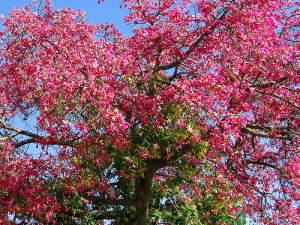
A silk floss tree in bloom. Photo by Daniel Orth; used under Creative Commons attribution license.

Some days it’s possible to maintain an awareness that we’re really here to connect with that divine spark inside our fellow human beings and all of creation, to notice the miracle in the profoundly pink blossoms of a silk floss tree, to be kind, be kind, be kind. Some days, I might even see the value in loving my enemies. And other days, it’s all I can do to keep from throttling my friends.

I used to think the friend-almost-throttling days were a failure, but maybe not; maybe, for that day, they’re a tremendous success. After all, no strangulation occurred. Maybe grinding my teeth and doing nothing on the less enlightened days is as much a step toward loving my enemies as being kind is on the easier days.

Ronald Rolheiser said the first thing that ever made sense to me about Jesus on the cross, which is that he demonstrated how to hold, carry and transform whatever hurtful energy is directed at us. We are a mirroring species. If someone glances up to see a passing bird, we glance up, too. If someone likes us, we tend to like them, and if they dislike us, we usually return the favor.

So to really change anything rather than just reflect back what we get, we have to hold, carry and transform that energy. I don’t know why, but I think our capacity to do that is not the same every day. My conception of my best used to be that every day I would be the most efficient, disciplined and intelligent achiever of things that I could imagine. Now, I’m pretty sure that I’ll never reach what I can imagine, and I’m convinced that some days will be impressive and some will be of the not throttling variety.

But not throttling still contains an iota of holding, carrying and transforming, and it’s a lot better than the alternative.