As We Are

I seem to be retreat/relaxation challenged. I spent a long weekend at a cabin in Yosemite, and the first two days were reminiscent of my monastery experience.

I worried that I would break some complicated apparatus, such as the stove, or that I would need to ask the neighbors to help me fill the water tank and they would hate me, which as everyone knows is how most rational human beings react when someone asks for help. Mind you, I hadn’t even checked the tank.

wildflowerAt this point I did the only sensible thing and went for a walk. (For those of you who are plot-driven, the tank was full and the neighbors brought me chocolate chip cookies—the best of all possible endings.) On one hillside, I saw a wildflower that starts life curled up like a fern. A few of the blossoms had just begun to poke out into white spikes.

The flowers reminded me of one of my least favorite phrases in the whole world: Let all things be exactly as they are. Unfortunately, they argued in favor of it.

Some reasons to hate this saying: war, poverty, mass species extinction, etc. But wildflowers have no control over whether they happen to spring up on the posh hillside or on some less desirable slope, and what good will it do them to try for spiky, white petals before springtime?

Did the other half of Half Dome want to remain in place, or did it strive to break off before the ice age? Either way, hard to argue with a glacier or lack thereof.

Part of me still resists things as they are, but part of me says, trust the glaciers. The water tank may be full. The neighbors may bring cookies. We will bloom or break when it’s time, and either result may be unexpectedly beautiful.

Moving on

Even the best of beginnings inevitably entail endings. There doesn’t seem to be any getting around the reality that change involves the breaking—or at least loosening—of some bonds and the creation of others.

I will start a new job soon, a job I’m excited about. This week, though, I’ve felt rather wistful and melancholy about leaving my current office. I like to think of it as overachieving to get nostalgic about a place while still there.

Some things that make me sad:
•    No longer being on the About page of our website
•    My desk not being my desk
•    Not being invited to birthday lunches anymore
•    Most of all, no longer seeing the people I currently work with on a daily basis

We choose so few of our relationships in life. With the exception of spouses, the selection of the people we spend the most time with—our families and our coworkers—is beyond our control. We get to pick among the applicants for a job, but because a person is so much more than a collection of skills, an hour-long interview gives little idea of who will walk through the door.

I’ve been extraordinarily lucky in my current officemates and how much we enjoy each other. Everyone knows the work-day rituals; there is comfort in the well-worn grooves of relationships and the familiarity of our banter. We laugh a lot. And these people all make really good food—the importance of that talent cannot be underestimated.

I will see these folks again, but lives get busy and there is no substitute for time spent together. The group I’m joining is similarly tight knit and good humored, so the future is bright. But for now, I want to acknowledge how much I appreciate my current crew and how much I will miss them.

Let It Be

If authors did risk assessments, no one would ever begin a book. I’ve been working on a new novel for a little while and have only pieces of the world my characters inhabit, pieces that may never coalesce into a whole. I could spend five years writing this story and still not discover the crucial turn in the plot.

Considering how little faith I often have in simple things, this uncertainty should unhinge me. For example, I will check and double-check all the letters in a mail merge, as if the name field goblin might infiltrate Microsoft Word and match Joe’s address with Sally’s salutation. Given that impressive paranoia, I have a surprising amount of faith in this emerging novel, even though it still refuses to let me get too structured about things—no outlining allowed.

Established relationships are more comfortable, more familiar. In my already completed novel, I know the characters and the terrain—both emotional and geographical—intimately. I’m fond of the people and the place.

But this void of beginning offers a paradoxical peacefulness. There is nothing to do but wait for the novel to reveal itself. The usual poking and prodding and futurizing I engage in with the other aspects of my life will only shut the door this book-to-be is entering through.

Maybe all beginnings have this openness to them only we don’t realize it. We are too focused on getting to where we think whatever it is—our life, our relationship, our dinner—should go. We hardly even realize we’re participating in the creation of something new because we’re so focused on the completion of it.

It might help to watch more parts of my life unfold like unwritten novels that I can’t force ahead of where they are. It would help with the fretting.

What Gets Measured Gets Done

There are some really efficient people in this world, but I am not one of them. I am slow—at just about everything—and yet I want to be one of those people who gets a lot done.

I probably should not answer the “how am I doing at this life thing anyway?” question by counting tasks accomplished because the result will not be pretty. For other people, this approach might really work. Martha Stewart is probably a kick-ass list-item crosser-offer.

hummingbirdMy measurement system, on the other hand, needs to include such things as, did I notice the hummingbird hovering near the bottle brush tree? Did I taste my food rather than just gobble it down so I could go to the gym at lunch? Paying attention to these details makes me feel more alive and, as Howard Thurman says, “What the world needs is people who have come alive.”

Now you might say, doesn’t everyone want more hummingbirds in their life? If so, then the joy and peace quotient can only increase if people hang feeders and spend their evenings watching the little guys buzz each other.

But maybe not everyone is interested in hummingbirds. Not everyone wants to write—some people really enjoy being accountants. I am not making this up, though it is as incomprehensible to me as my voluntarily choosing to write a blog is to them.

Is it cheating to pick the indicators that will reveal we’re all doing a great job? Maybe, but would you choose an architect based on what kind of omelet he makes? No, so if you’re a born omelet-maker, why judge yourself on the kind of blueprints you draw just because the society you happen to live in thinks blueprint drawing is really cool?

It’s often hard to discern whether we’re omelet-makers, lawyers, or musicians, but if we measure our accomplishments in units of liveliness, we will head in the right direction.

Of Otters, Kayaks and Mortality

When I go sea kayaking with my dad, I spend a good amount of time thinking I am going to die. Never mind that he refuses to take me anywhere except protected bays.

Dad once told me a story of some unfortunate couple in a small craft getting creamed by a tanker. I translated this to all boats with motors simultaneously will not notice and are gunning for all small, oar or paddle-driven boats. If you think those psychos in their outboard-powered death machines cannot both ignore and aim for something at the same time, you are not using your imagination (see post on fretting).

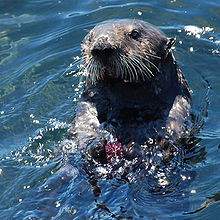
sea otterThis time, however, another threat presented itself. We were heading out toward the breakwater, that is, more than 100 yards from shore. Though still protected, it appeared that we would come close enough to the open ocean that it would insist on pulling me out to a watery grave.

A boat did, of course, try to run me over on the way out, by which I mean, I paddled in front of it while it was close enough to be visible. After this near-death encounter, Dad instructed me to stay away from the towering, foot-high breakers with the apparently clear-to-him instructions, “Don’t go where they are.” Breakers tend to separate me from my kayak.

Then the day improved dramatically. Aside from my not dying, I saw a sea otter floating nearby. As I approached, he flipped off his back and stuck just his head out of the water, watching until I reached some invisible line at which point he dove underwater and resurfaced a short distance away.

Sea otters are the Spinal Tap of cuteness—eleven on a scale of one to ten. Bobbing on the water only a few dozen yards from the poster animal for adorable, I felt a tremendous sense of accomplishment. Braving the boats and the tides suddenly felt completely worthwhile. Doing things that frighten us doesn’t always pay off this well, but it often does. It’s helpful to remember that after the unpleasant, scary part, the universe might throw in some otters.