What’s the Use?

There is a story about a bunch of trees on a hillside, and all of them are cut down except one that is so old and gnarled it’s not useful for anything. Despite the wisdom of this story, I recently discovered I’d rather spend a lifetime thinking M&Ms were the pinnacle of chocolate-dom than have people consider me useless.

gnarled pine tree in sand
Photo by Dan Mahr. Used under Creative Commons License.

This idea of usefulness did not come from me but from someone in a dialogue group I attend regularly. In this group, we often experiment with interrupting something we habitually do, and my reaction to the possibility of not being useful to people was panic. Why would anyone like me if I no longer did the things they counted on me for?

I suspect the only human beings who don’t worry about their usefulness are kids lucky enough  to be raised in a loving family that has the means to provide for them. Even then, the time to enjoy a state of uselessness is brief.

We start training our children to be useful early in their lives, as soon as they are able to put away their own toys. Then we give them small chores to do and ask them to carry their own backpacks at the airport.

It’s not unreasonable training. We’re social creatures, and we’re teaching our kids how to get along in society, how to become valued and integrated members of the tribe.

I wonder, though, if part of what Jesus meant when he counseled us to be like little children was to put down our usefulness occasionally, to give ourselves some time and space to be undefined, to allow the possibility of being valuable for some other reason than our contributions to family, friends, society. Parents don’t, after all, love their children because of their ability to do the dishes; they love them simply because they are who they are.

In the Tim Burton/Johnny Depp version of Charlie and the Chocolate Factory, Charlie explains to one of the other children that the great thing about candy is that, “Candy doesn’t have to have a point. That’s why it’s candy.”

It might be that we don’t have to have so much of a point as we think we do.
Falling into Place

I bribed my family to forego skiing in Colorado and come to California for Christmas. The winning offer: Dungeness crab at $6.99/lb.

We’ve never before gathered in California, and the four of us haven’t been together in quite a few years. When reflecting on what made the week so much fun, it appeared to me that we’re all at a point where we want to be with each other or are at least capable of enjoying the company. With the possible exception of the cat, who made it clear he objected to the disruption of his usual routine.

It’s not always easy to remember that things happen in stages. My sister is six years younger than I, and for years I didn’t want her around. In my late teens and early twenties, I didn’t want any of my family members around. By the time I returned to the fold, my sister had had about enough of all of us. The two of us have been close for years now, but it took some time.

The cycle turned again this year, and it felt as if things I didn’t even know were missing fell into place a little.

That’s not to say we’re perfect. My sister and I had to stop speaking about a photograph because we disagreed so strongly about its contents. My parents are divorced, and though they did us the gigantic favor of not hating each other, they are not those people you see in the movies who remain close friends.

Yet we all seem to have come to a place where, most of the time, we don’t need each other to be any more or less than who we are. The other side of the coin, I think, is that we all have some acceptance of our own failings. We can, mostly, listen to stories about ourselves and say, wow, did I really do that? A gentler reaction than, I did not do that!

The future undoubtedly holds anger and frustration along with the joy and love, but this Christmas felt like a healing, as if something was sewn together that will make our relationships stronger in the future. And that is a remarkable gift.

On Big and Small Steps

Any sane person knows that “a.m.” shouldn’t really be combined with “5:30” in any sort of active sentence. Nonetheless, I sometimes run with friends around this time before work.

Some days are harder than others, not because we run farther—we don’t—just because they are. On these days, I talk us through the last few blocks about 20 meters at a time. It goes something like this, “Just make it to that car, now to that mailbox, now to the tree.” It’s amazing how much more possible it feels to finish these small chunks than to finish the whole run.

But do I replicate this practice in my day to day life? Not so much. I prefer to concentrate on the end product as a giant, overwhelming thing to freak out about.

Never mind that everyone from the Buddha to E.L. Doctorow to David Allen to bad ‘70s sitcoms have pointed out that it’s not actually possible to complete an entire journey, novel, project at once. They all subscribe to that one step at a time philosophy. When else have an enlightened being, an author, an efficiency expert, and Hollywood ever agreed on anything? I mean aside from the time they all shared a box of Trader Joe’s dark chocolate sea salt caramels.

In his book Getting Things Done, David Allen explains how you can’t actually do a project, say landscape a yard, you can only do the smaller actions that add up to some state you consider done—pull out the old plants, fertilize the soil, etc. So the idea of focusing on the journey instead of the destination may simply be practical advice instead of deep and mysterious spiritual direction.

And yet it’s usually my last resort, somewhere after pulling out my hair and before drinking. My resistance might have something to do with the previously discussed lack of patience or perhaps some slightly unrealistic expectations. If you have suggestions on how to join the ranks of the contented and well-organized step-by-steppers, leave them in the comments. In the meantime, pass the caramels.

Note: The blog and I will be on vacation next week. Merry Christmas, belated Happy Hanukkah, Happy Solstice—enjoy your various celebrations of the returning of light.

Why Wait?

My life would be a lot easier if impatience were a virtue. Or if I could learn patience faster.

Recently, I’ve been telling myself to buckle down and do more of approximately everything. Myself and I have had this conversation often with no discernible results. So for Advent I decided to stop trying to figure things out and wait and listen instead. This may be what some people refer to as praying.

Our culture doesn’t particularly value waiting, and after two weeks of practicing it, I understand why. The first couple of days you can feel all la-dee-da and enlightened about it, but beginning day three it’s just not fun. The subtitle on the Advent reader they handed out at church says, “Waiting in joyful hope.” I’m not sure where the joyful hope people are, but I’m hanging out in the annoyed get-it-over-with-already camp.

Today I decided that two weeks is quite enough time for God/the universe/whatever to have straightened out my life and revealed at least the next few steps in a clear, concise road map. Unfortunately, as is so often the case, God/the universe/whatever doesn’t appear to be on my timeline, despite my having told her/him/it very sternly in the car on the way home that I’d had about enough of waiting.

But here’s the thing, the point of these four weeks is for people to make a straight path for God, not the other way around. We’re getting ready to celebrate a birth, and though I don’t have any kids, I’ve attended enough baby showers to know that requires a lot of preparation.

Once it happens, your life, as I understand it, does not get easier. Suddenly your time is no longer you own, and this tiny being has the power to disrupt your sleeping and eating and showering in ways previously unimagined. It also has the power to open up a richness and a depth of love that little else can provide.

So that’s what we’re preparing to celebrate, that opening of love in our lives. I suppose it might be worth waiting for.

I just asked my cat if he would like to curl up in my lap and act inspirational while I write. He replied by knocking my pen off the table.

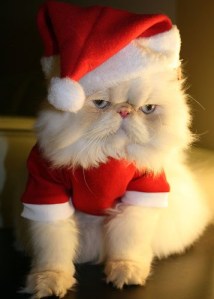
cat in Santa costume looking sour

That’s the great thing about being a cat: you somehow manage to be charming by failing to fulfill any social obligations. Humans do not have this luxury, especially during the current extreme sports season of gathering and gifting. Everyone is competing in at least a heptathlon—sending cards, buying presents, attending parties, caroling, baking.

I’ve found that the key to an enjoyable holiday season is focusing on the aspects that you’re really good at. For me, one shining skill stands out above all the others: eating.

In these health conscious days, where would all the cookie bakers be without people like me to consume their wares? Who would support the red and green sprinkle industry and ensure the Red No. 5 factories stayed open?

And imagine a holiday party at which no one touched the spinach dip. Don’t linger on that thought lest you lose your good cheer.

In fact, an expert eater may be the person most likely to go the distance. Consider: the season starts with the biggest feast day of the year, Thanksgiving, the one day of the American calendar devoted solely to cooking and eating. Then as soon as you’ve finished the leftovers, the first party arrives. Hanukkah gelt fills in any momentary gaps, and even the decorations are edible—gingerbread houses, candy canes.

So though my Christmas cards remain scanty and my shopping last minute, I think I’m sitting right at the heart of the season.

What We Need

You have everything you need was the theme of our church retreat this week. Apparently it’s going to take me more than one day to master that concept.

To find out how truly bad you are at knowing what you need, go to a buffet. I went to two very good ones in one fabulous day this week.

In case you’ve forgotten, at a buffet, all the food is infinitely replenished. You cannot run out. The person in front of you cannot take the last piece of Tandoori chicken because the kitchen will bring more. Because it is a buffet.

Is my reaction to this state of abundance relief, peace, and contentment? Do I think, wow, there is more food here than I and everyone else in the room could ever eat in one sitting, what a wonderful, relaxing, rare, and magical situation in which to find myself?

If you guessed that the answer to the above questions is yes, thank you. You must be new to reading the blog. Alas, you are also mistaken.

My first instinct is to load up my plate to ensure that I get my fair share. I worry that I won’t get enough when too much is guaranteed. I avoid painful overeating only by holding myself strictly in check, like Dr. Strangelove fighting down his arm as it tries to salute. (If you haven’t seen Dr. Strangelove, you’re leading a deprived life. You can find out how deprived by watching this clip.)

So my judgment of what I need may be a tiny bit off, say three or four stomach’s worth. I might try remembering the buffet problem when my mind is working to convince me I can’t live without the latest whizbang whoozewutsit.

Of course if it’s a chocolate whoozewutsit, bring on the buffet.

Life is Good

‘Tis the season to remember everything that makes this life fabulous. My gratitude list for 2012—partial of course:

Colors, all types, from Rothko’s squares to that electric turquoise fashionable in purses a season or two back to the jacaranda tree’s purple flowers.

The days Elm St. is inexplicably empty allowing me to catch the van despite the the space-time continuum’s attempts to thwart me.

The way that people’s creativity flourishes in different mediums—paint, clothing, conversation, leadership, gardens.

The rotations of nature, from seasonal changes to a single day’s palette of light, morning’s yellow, speaking of promise, distinct from evening’s paler shade of repose.

Food—that it exists, that we are required to eat it, that one of its subcategories is chocolate, that said subcategory correlates with production of Nobel Prize winners. I am not making this up. Read the article on chocolate and Nobel Prizes. Thanks to my aunt for passing on this essential knowledge.

The times I remember to pray instead of attempting to solve something far beyond my powers.

Quirky things—people, movies, my cat, possibly all cats.

The astonishing difference a smile can make in someone’s day.

The times I remember to have a sense of humor about myself.

People—the ones who are passionate; the ones who do jobs I never could, such as home healthcare worker or probation officer; the ones who are incalculably kind; the ones who love me and tell me I’m doing a wonderful job of being human on those days I can’t find that belief anywhere in my universe.

The stunning abundance of all these things in the lives of so many. Here’s hoping that this time next year, those who lack food or love or the chance to express their creativity are sharing in the abundance.

Losing the Edge

The edges of my life are fraying. I like edges. They look clean and crisp and clearly mark where one thing ends and the next begins. I never was a color outside the lines kid and didn’t appreciate it when others played fast and loose with the boundaries in my coloring book.

But life apparently prefers watercolors and things are bleeding into each other at an alarming rate. By things I mean work and life because clearly work isn’t life; it’s some alternate universe we enter at eight and leave at five. Through the door in the toadstool after eating the mysterious cake.

The idea that a little less than 5/7 of my time doesn’t count as my life is a little absurd to begin with. It’s even stranger if you consider that people from work become good friends and are invited into the other realm. And of course no membrane prevents work experiences from infiltrating the way I think about the world or vice versa. To switch metaphors, the peas got mixed up with the mashed potatoes long before now.

Yet I’ve always considered work as other, probably because then it can be contained in a neat, little package and dropped at the side of the road when my real life comes along. If work doesn’t count, then I haven’t, for example, irrevocably not published a book because I’m not truly committed to anything else.

Maintaining this level of self-delusion requires serious talent. Let’s examine some evidence. If the amount of time I spend thinking about work while cooking dinner or taking a shower is any indication, I do value my work, thank goodness. Who wants to spend all that time doing something that feels like a waste? And believing that holding work as unimportant will help me accomplish other goals is like training for a marathon by not swimming.

It’s scary, though. If I give work official life status, what’s to keep it from smearing purple crayon all over the coloring book? This concern is probably as relevant to my life as the fear that I may become a couch potato, which, when discussed with a friend, elicited the response, “As if.”

Be Kind, Be Kind, Be Kind

I voted today. Tomorrow, or tonight if you stay up late enough, almost everyone will have a reason to despair because of the results of a local or national election.

I believe, however, that neither politics nor economics ultimately decides the quality of our lives. I am not saying these systems don’t affect us. A leader’s decision to go to war, for example, changes lives forever. I am saying that there are other, more powerful forces at play.

I base this conclusion on the version of history taught in American primary education, which is mostly if not exclusively politics and economics. If history consisted only of the events in the history books, I’m convinced the human race would have wiped itself out long ago because, according to the official version, very little good ever happens. People and nations in power attempt to retain or expand that power and harm or kill a lot of other people along the way. If nothing stood in opposition to that story, the world would be a much more dismal place than it is.

I think what keeps or doesn’t keep us going is how kind we are to one another. While trying to figure out the motivation of the characters in my novel, I wrote to a few friends and asked them what they wanted out of life and why. My former Chinese religion professor wrote back and said, “Be kind, be kind, be kind.”

At the time I thought, that is not an answer, but now I wonder if it might be the only one worth pursuing.

Much of life is beyond our control, even in a country where we get to choose our leaders and in certain cases our laws. Sometimes being kind is all we can do for another person and all we can do for ourselves.

I think we often see kindness as a small gesture and forget what a tremendous difference it can make. It can change the course of history.

Not Going to Extremes

In my hometown, keeping up with the Joneses didn’t have anything to do with the brand of your car or the size of your house. It meant running an ultramarathon the day after your soccer tournament. At 10,000 feet elevation. In the snow. Backwards.

Being surrounded by people rock climbing, skiing avalanche chutes, and boating class five rapids made it easy to believe that these activities made you feel the most alive. I often thought I should be doing something more death defying, dangerous, or at least generally uncomfortable. If you’d asked me why, I would have said those things counted more, though I might not have been able to tell you what we were counting.

Now, I work with faculty members who are equally extreme but in a different way. The number of projects their jobs demand they juggle both impresses me and makes me dizzy. A hypothetical one-person sample: teaching three classes, running their own research—which includes supervising students—organizing a conference, preparing reams of documents for their professional review, being a mom/dad, not to mention those unexpected items life throws at you.

I used to feel like a slacker compared to people who run their lives this way. Recently, a new feeling has crept in—sanity. I worry a little bit (because after all, what’s life without at least some fretting?) that no longer expecting myself to keep up that pace means I’m getting old and complacent, but the amount of activity we expect ourselves to do in this culture is not reasonable or healthy.

A few people might thrive on constant motion. But no one I know rattles off impossibly long to-do lists with joy, and my colleagues so often look slightly harried.

As usual, someone else has already said it better than I can. This time it’s the Sufi poet Hafiz. He says,

When all your desires are distilled
You will cast just two votes:
To love more,
And be happy.
(translation by Daniel Ladinsky)

I don’t think a longer list will help us with either one of those.