Time Flies

I am not an early adopter. When my sister first got a livejournal account, my enlightened reaction was something along the lines of, “Blogs are stupid. Who would do that?” A diary anyone in the world could read had all the appeal of the unidentified, molding substance in the back of my refrigerator. Today, thanks to leap year, Being Finite is exactly one year old.

I didn’t anticipate enjoying blogging. Even though most posts keep me up past my bedtime, I’m always grateful for the writing of them. They keep me honest, and they remind me to look for “things that help when life gets difficult,” to quote the About blurb. I’ve discovered, much to my surprise, that what helps is telling stories about my limitations, quirks, amazing friends and family, lousy days, and moments of gratitude.

It’s remarkably humbling to hear about my posts striking a chord with others or making them laugh. My original plan, quickly abandoned due to complete lack of research, consisted of finding other people and groups doing impressively helpful things. I didn’t expect my life to make interesting material. Readers’ reactions bring home what many have said, that all we really have to offer is our unique existence in this world, and that is enough.

What’s made the last year both enjoyable and humbling is you who read and comment and like, who share and smile about a post on the van, who reference the blog in a conversation, whether spoken or digital. Thank you for sticking with me, for encouraging me, for giving me a reason to write as clearly and thoughtfully as I can at 11 p.m.

Here’s hoping we’re still sharing pixels this time next year.

As We Are

I seem to be retreat/relaxation challenged. I spent a long weekend at a cabin in Yosemite, and the first two days were reminiscent of my monastery experience.

I worried that I would break some complicated apparatus, such as the stove, or that I would need to ask the neighbors to help me fill the water tank and they would hate me, which as everyone knows is how most rational human beings react when someone asks for help. Mind you, I hadn’t even checked the tank.

wildflowerAt this point I did the only sensible thing and went for a walk. (For those of you who are plot-driven, the tank was full and the neighbors brought me chocolate chip cookies—the best of all possible endings.) On one hillside, I saw a wildflower that starts life curled up like a fern. A few of the blossoms had just begun to poke out into white spikes.

The flowers reminded me of one of my least favorite phrases in the whole world: Let all things be exactly as they are. Unfortunately, they argued in favor of it.

Some reasons to hate this saying: war, poverty, mass species extinction, etc. But wildflowers have no control over whether they happen to spring up on the posh hillside or on some less desirable slope, and what good will it do them to try for spiky, white petals before springtime?

Did the other half of Half Dome want to remain in place, or did it strive to break off before the ice age? Either way, hard to argue with a glacier or lack thereof.

Part of me still resists things as they are, but part of me says, trust the glaciers. The water tank may be full. The neighbors may bring cookies. We will bloom or break when it’s time, and either result may be unexpectedly beautiful.

Moving on

Even the best of beginnings inevitably entail endings. There doesn’t seem to be any getting around the reality that change involves the breaking—or at least loosening—of some bonds and the creation of others.

I will start a new job soon, a job I’m excited about. This week, though, I’ve felt rather wistful and melancholy about leaving my current office. I like to think of it as overachieving to get nostalgic about a place while still there.

Some things that make me sad:
•    No longer being on the About page of our website
•    My desk not being my desk
•    Not being invited to birthday lunches anymore
•    Most of all, no longer seeing the people I currently work with on a daily basis

We choose so few of our relationships in life. With the exception of spouses, the selection of the people we spend the most time with—our families and our coworkers—is beyond our control. We get to pick among the applicants for a job, but because a person is so much more than a collection of skills, an hour-long interview gives little idea of who will walk through the door.

I’ve been extraordinarily lucky in my current officemates and how much we enjoy each other. Everyone knows the work-day rituals; there is comfort in the well-worn grooves of relationships and the familiarity of our banter. We laugh a lot. And these people all make really good food—the importance of that talent cannot be underestimated.

I will see these folks again, but lives get busy and there is no substitute for time spent together. The group I’m joining is similarly tight knit and good humored, so the future is bright. But for now, I want to acknowledge how much I appreciate my current crew and how much I will miss them.

Let It Be

If authors did risk assessments, no one would ever begin a book. I’ve been working on a new novel for a little while and have only pieces of the world my characters inhabit, pieces that may never coalesce into a whole. I could spend five years writing this story and still not discover the crucial turn in the plot.

Considering how little faith I often have in simple things, this uncertainty should unhinge me. For example, I will check and double-check all the letters in a mail merge, as if the name field goblin might infiltrate Microsoft Word and match Joe’s address with Sally’s salutation. Given that impressive paranoia, I have a surprising amount of faith in this emerging novel, even though it still refuses to let me get too structured about things—no outlining allowed.

Established relationships are more comfortable, more familiar. In my already completed novel, I know the characters and the terrain—both emotional and geographical—intimately. I’m fond of the people and the place.

But this void of beginning offers a paradoxical peacefulness. There is nothing to do but wait for the novel to reveal itself. The usual poking and prodding and futurizing I engage in with the other aspects of my life will only shut the door this book-to-be is entering through.

Maybe all beginnings have this openness to them only we don’t realize it. We are too focused on getting to where we think whatever it is—our life, our relationship, our dinner—should go. We hardly even realize we’re participating in the creation of something new because we’re so focused on the completion of it.

It might help to watch more parts of my life unfold like unwritten novels that I can’t force ahead of where they are. It would help with the fretting.

What Gets Measured Gets Done

There are some really efficient people in this world, but I am not one of them. I am slow—at just about everything—and yet I want to be one of those people who gets a lot done.

I probably should not answer the “how am I doing at this life thing anyway?” question by counting tasks accomplished because the result will not be pretty. For other people, this approach might really work. Martha Stewart is probably a kick-ass list-item crosser-offer.

hummingbirdMy measurement system, on the other hand, needs to include such things as, did I notice the hummingbird hovering near the bottle brush tree? Did I taste my food rather than just gobble it down so I could go to the gym at lunch? Paying attention to these details makes me feel more alive and, as Howard Thurman says, “What the world needs is people who have come alive.”

Now you might say, doesn’t everyone want more hummingbirds in their life? If so, then the joy and peace quotient can only increase if people hang feeders and spend their evenings watching the little guys buzz each other.

But maybe not everyone is interested in hummingbirds. Not everyone wants to write—some people really enjoy being accountants. I am not making this up, though it is as incomprehensible to me as my voluntarily choosing to write a blog is to them.

Is it cheating to pick the indicators that will reveal we’re all doing a great job? Maybe, but would you choose an architect based on what kind of omelet he makes? No, so if you’re a born omelet-maker, why judge yourself on the kind of blueprints you draw just because the society you happen to live in thinks blueprint drawing is really cool?

It’s often hard to discern whether we’re omelet-makers, lawyers, or musicians, but if we measure our accomplishments in units of liveliness, we will head in the right direction.

Of Otters, Kayaks and Mortality

When I go sea kayaking with my dad, I spend a good amount of time thinking I am going to die. Never mind that he refuses to take me anywhere except protected bays.

Dad once told me a story of some unfortunate couple in a small craft getting creamed by a tanker. I translated this to all boats with motors simultaneously will not notice and are gunning for all small, oar or paddle-driven boats. If you think those psychos in their outboard-powered death machines cannot both ignore and aim for something at the same time, you are not using your imagination (see post on fretting).

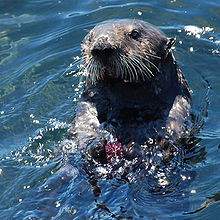
sea otterThis time, however, another threat presented itself. We were heading out toward the breakwater, that is, more than 100 yards from shore. Though still protected, it appeared that we would come close enough to the open ocean that it would insist on pulling me out to a watery grave.

A boat did, of course, try to run me over on the way out, by which I mean, I paddled in front of it while it was close enough to be visible. After this near-death encounter, Dad instructed me to stay away from the towering, foot-high breakers with the apparently clear-to-him instructions, “Don’t go where they are.” Breakers tend to separate me from my kayak.

Then the day improved dramatically. Aside from my not dying, I saw a sea otter floating nearby. As I approached, he flipped off his back and stuck just his head out of the water, watching until I reached some invisible line at which point he dove underwater and resurfaced a short distance away.

Sea otters are the Spinal Tap of cuteness—eleven on a scale of one to ten. Bobbing on the water only a few dozen yards from the poster animal for adorable, I felt a tremendous sense of accomplishment. Braving the boats and the tides suddenly felt completely worthwhile. Doing things that frighten us doesn’t always pay off this well, but it often does. It’s helpful to remember that after the unpleasant, scary part, the universe might throw in some otters.

Roses Are More Than Red

When I need to escape at work, I go to the rose garden. It sits on the edge of an area where beautiful spots congregate. It seems a bit unfair that the spots don’t spread out, especially since they surround the College of Business, as if to show that money really can buy happiness.

Last time I was there, I saw a man with a hoe inspecting the flowers and thanked him for his work. Turns out he has been tending that part of campus for thirty years and created not only the rose garden but also the cactus garden across the lawn, not to mention a sheltered dirt path that always feels as if you’ve found a secret place none of the other 20,000 people on campus know about.

So did I ask this person who created one of my favorite spots what kind of connection he’d forged with the piece of earth he’d tended for thirty years? What it feels like to know a location so intimately? Why he decided to plant a rose garden? What his favorite flower is?

No. I don’t remember exactly what I said, but it resembled “Sure is warm today, isn’t it?”

I used to hate small talk. My answer to the weather question was “Yes.” This approach did not help me at parties. Then I realized that small talk isn’t evil and vacuous; it’s useful and vacuous. It puts many people at ease, and in a world where so many of us spend so much time wondering what we’re doing wrong, providing a little mind balm is not necessarily a bad idea.

But it’s a shame to make such a habit of it that when you meet the man responsible for a particularly beautiful corner of earth, you can’t get beyond thank you. I hope I get to see him again and get another chance to learn something real about this place and the person who cares for it. In the meantime, I am going to assume that his favorite rose is the same as mine, the orange and yellow one that somehow manages to bloom in at least three shades at once.

Getting Friendly

You will have to forgive me if this post occasionally slips into a not-as-funny-as-Tina-Fey imitation of Tina Fey. I read Bossypants over the weekend. Well, OK, I read Bossypants until 2 a.m. Sunday morning.

All Americans should read this book. (It is strongly grounded in U.S. culture and so may not be funny to non-Americans.) Both my cat and I were disturbed by how hard I could laugh sitting in a room by myself.

After finishing the book, I decided that clearly the best way to appreciate the experience was to go straight into “oh my God what have I done by ignoring all my really important tasks to read this book” mode. This mode leads not to any action that might improve the situation but rather to a really good reason not to get up in the morning. I decided to feel sorry for myself for five minutes before beginning the day.

In those ten minutes (I needed an extension.), a rare thing happened: I recognized that I was feeling inadequate. My usual reaction to any emotion except happiness or peacefulness is, “La, la, la, I’m not listening.” The really top notch reasoning behind that reaction goes something like this: if I feel inadequate, maybe I am, and that’s too scary to actually be conscious of.

“Bad” emotions are not nearly so unpleasant when we stop being afraid of them. Years ago, in China, I spent a lot of time feeling lonely, enough time that loneliness shrank from a giant ogre to a small gnome. We became buddies. I’d open the door and say, “Oh, loneliness, it’s you, come on in,” similar to what Rumi describes in his poem, “The Guesthouse.”

It is not a newsflash to say we are afraid of our emotions in this country. One tiny illustration: perhaps more than anything else, we value and spend time being professionals. Expressing feelings, other than pride in a job well done, is generally considered unprofessional.

I find it mildly disturbing that it took me thirty-seven years to recognize feeling inadequate. I’m sure we’ve spent some time together; I’m sure we’ll spend some more, but maybe the next visit will be more friendly.

The Fretting Gene

Someday, they will isolate the gene for worrying. At that time, a great quandary will face the human race: should it be genetically engineered in or out?

Arguments against the gene:

  1. The medical community seems to believe that stress is not good for you, and I have yet to encounter worry without stress.
  2. Worrying is not particularly enjoyable.
  3. The Visit wrapped up last Thursday morning. It was, by all measures, a stunning success (she said humbly). On Saturday, I dreamt that I’d failed to plan a way for our visitors—who you will remember had gone home two days earlier—to get to Easter mass. Apparently my ability to produce anxiety can overcome both the separation of church and state and the space-time continuum.

Arguments for the gene:

  1. One non-worrying friend claims that only worriers can write novels because writers have to imagine horrible things happening to their characters. When I caught myself thinking that some student research posters might get stolen out of the back seat of my car at Office Max, I decided there might be something to this theory. I had to tell myself sternly that no one nearby wanted to know about albino quail enough to break into my car.
  2. Another friend who doesn’t worry told me multiple times over the last month, “Don’t fret.” What American would even remember such a fine word as “fret” if she didn’t have someone telling her not to do it? This argument is only applicable if you know someone British.

Calm and peaceful friend number one also contends that whether or not you think up every possible calamity, you end up in approximately the same place. That is the problem with non-worriers—they lack the imagination to recognize that the rest of us are holding the world together. So those of you who think things just work out should thank the rest of us for saving you from the hordes of giant, rabid, albino quail.