Share the Wow

I have a lot of older friends, and I have serious retirement envy. Having recently attended yet another retirement party, I have one more reason to look forward to that occasion—people say a lot of nice things about you.

As the speeches were starting, the person whose party it was said, “I hate these things. They’re like funerals except you’re here.” Just as extended families sometimes never gather except for weddings and funerals, we humans tend to save all the good things we have to say about each other for leave-takings or eulogies. Why do we wait until the end of things to tell others what we appreciate about them? Why not do it along the way?

It’s hard, I think. It took me a long time to learn even to compliment a new dress or pair of earrings, much less tell someone I admired the way she ran a meeting or wrote a sentence. It feels unprotected, not knowing how the person will receive or react to the compliment. It is a little bit like saying, “I love you” without being certain of the reply.

Giving someone else credit is a deeply humble act. We take ourselves out of the picture for a moment; we abdicate control of the situation; we do not know whether the gift will be accepted. If we can get over that momentary panic of self-disappearance, though, it feels good to voice the wows we often think to ourselves but sometimes don’t say.

With practice, it might get easier. We might discover that, strange as it may sound, others are delighted to hear what they’re good at. They may not know what to say in return; they may shrug it off or try to deny it because they are as out of practice at accepting praise as we are at giving it. But I can think of many less-pleasant things to spend time practicing.


Going Down?

As with economies, so with emotions—what goes up is generally followed by something decidedly less enjoyable. So after a rather extended adrenaline rush finishing the infamous report, there followed a week of exhaustion and then … the crash.

Almost. You may know these moments, the times when the world, which had been sunny an hour or a day before, suddenly turns to complete crap. These moments are very convincing. I’m usually somewhere in the middle of one before realizing nothing has changed from the time when everything was not crap. By then it is often too late.

Contrary to my usual practice, I anticipated this downturn; I knew the end of an intense project would eventually lead to withdrawal. The early stages of the crash had clearly arrived when my mind started to play a “you really suck” advertisement: I would never catch up with the details of my life—financial, household, relational, you name it—never send another query letter to an agent, and certainly never get married. “Never” is a good clue that you’re losing altitude.

I watched myself totter on the edge, contemplating the descent. The poet David Whyte says sometimes he sees himself walk up to the edge of the pit of feeling deeply sorry for himself and jump in and on the way down he thinks, this is going to be a good one.

I couldn’t quite decide whether I needed to wallow in self-pity for a while or whether a more pleasant route might be available. Of course if you’re asking that question, you’re already climbing down the well. Despite having multiple tools at my disposal for turning around—gratitude, exercise, chocolate—I was apparently going to refuse to use any of them.

Then somewhere in the middle of making breakfast, the universe shifted. By the time my eggs were fried, the urge to indulge in “poor me” had passed, like those times on the highway when things are inches away from going bad and everyone sails on through as if there had been no danger. It wasn’t my doing. It was grace or good fortune, depending on your world view.

I’m grateful to have survived unscathed this time. I have no illusions that every encounter with the abyss will end so well, but I am cheered by the memory of thinking, “Feeling miserable is really not going to be much fun.” That’s the beginning of sanity.

What We’re Given

For those who have been anxiously awaiting the fate of THE REPORT, we dropped it in the big UPS box Monday afternoon, and it miraculously arrived at its multiple destinations, including Hawaii, the next day. I have added whoever invented overnight delivery to my list of personal heroes.

giant smiley face on garage door
My mom's reaction to our finishing the report. Yes, that is my garage door.

As I worked a few long days on the final details, it occurred to me that worrying so much about a report is a great luxury. People worry about much more serious things in this world: having enough to eat, living through the sickness or death of a family member, ending a relationship, avoiding land mines. In this context, I consider being allowed the time and energy to shape a piece of research and writing as perfectly as possible an extraordinary gift.

Gifts like this don’t always appear immediately useful. They don’t end world hunger or stop gang violence. Those of us who worked on the report hope it will lead to improvements; it may or may not. The effort must somehow contain its own merit.

A few years ago, a group of Tibetan monks came to campus and constructed an exquisite mandala. After a week of painstaking work, they prayed over it then destroyed it and carried the sand to a local creek to be washed out to sea—a lesson in impermanence. Knowing the mandala’s end didn’t deter the monks from studying for years to learn the art, from paying attention to each grain they placed, or from creating a work of stunning beauty.

I am not claiming that our report has the spiritual significance of a mandala, and I hope it doesn’t get washed out to sea or even accidentally deleted from the server. I like to think, though, that we made good use of the time we were given, that we honored it by producing something good. Because what is there to do with a gift but accept it?

Homeward Bound

After a nine-year trial period, California’s Central Coast recently began to feel like home. Then I went and confused myself by going back to my hometown of Steamboat Springs, Colorado, for Christmas.

The week before leaving, I caught myself driving down the street enjoying this place I live, not judging it or categorizing it—a better or worse part of town, these attractive features, those not-so-desirable features. And oddly, after resisting it for so long, feeling at home didn’t scare me.

Barn in front of the Steamboat ski mountain
Steamboat Springs in all its glory.

Home is a potpourri. It includes a sense of belonging and acceptance—both of oneself and of the place—but also a familiarity, a sense that here, things are as they should be. It takes time for a spot of earth to transform into a home, and the process is somewhat mysterious.

After graduating from college and before moving to the Central Coast, I never lived anywhere more than two years. I never intended to stay, but at some point the prospect of finding the grocery store and post office all over again in a new town overwhelmed me.

During that itinerant period Steamboat held unqualified home status. It probably helped that I lived in the same house from preschool through my senior year and generally enjoyed childhood.

A good part of our self-concept is wrapped up in the corner of the world we choose to call home. For several years, I had a dual identity. In California, I’d say, “I’m going home for Christmas,” and when I was leaving Steamboat, I’d say, “I’m going home Sunday.” Even this year, I refused to raise my hand in church when the lector asked who was visiting from out of town.

I have yet to figure out what you lose and what you gain when your hometown is no longer your home. I do know Steamboat’s beauty makes my breath catch in a way it didn’t when I lived there. I also know I have lost the Coloradan’s conviction that you are not really living unless you have to contend with snow nine months of the year.

Driving to the airport in Denver on one of the only truly cold days during my trip, I saw an underdressed woman hitchhiking on the side of the road. She looked as if she were leaving somewhere rather than going to somewhere. The look on her face reminded me that I am incredibly fortunate to be able to do both.

Where Peace Comes From

World peace is difficult precisely because I couldn’t resist spending half an hour at the Calvin Klein 70% off sale this evening. I wanted to forego Calvin Klein not because they make their clothes in Asia or Latin America but because I need to get some sleep tonight to avoid imploding. Yet there I was.

We cannot create something we cannot imagine, and we have so little experience with peace. At a conference last spring, a presenter spoke about the connections our brains are and are not capable of making. She put the word “apple” up on the screen and asked the audience to get a mental picture of the word. She then showed a red apple, a green apple, and the Apple logo and asked the audience which image they had in mind. About half the audience, myself included, had pictured the Apple logo. “That result was not possible 20 years ago,” she said.

Twenty years ago we couldn’t have connected an existing concept—apple—to something that didn’t exist yet, the current Apple logo. And pre-iPod, pre-commercial Internet almost, only a handful of members from a 1991 audience would have pictured the Apple logo of the time—most of them hadn’t practiced that connection.

We imagine war every day. We build monuments to it. We watch movies about it. We play it in games. Enter Calvin Klein. How can we imagine peace if we can’t feel it within ourselves? And how can I feel it when I continue to do things I know don’t make me peaceful?

The amount of time I spend fighting myself—not wanting to get up, not wanting to go to work, not feeling I’ve gotten enough done—is much greater than the amount of time I spend at peace with myself—admiring a scarlet leaf shot through with sunlight, sitting still long enough for the cat to crawl up on my lap, feeling pride in an accomplishment. I suspect I am not unique in this internal war/peace ratio, yet we haven’t completely destroyed each other yet.

I think humanity has survived because peace is tremendously powerful. Ten seconds of peace must count for at least ten hours of strife. Which means even in our human-ness, in our infinite capacity for making mistakes, in our resistance to change, in our succumbing to the temptation of the fancy jacket reduced to $30, even in the midst of all that, if we spend just a few more moments breathing or appreciating, thanking or complimenting, being still or being astounded, we will add not drops but bucketfuls of peace to the world.

No one can say whether it will be enough, but let’s imagine what life will be like when it is.

Note: The blog and I will be on vacation next week. I wish everyone a Merry Christmas, Happy Hanukkah, Happy Solstice, and joyous celebrations of whatever other holidays you honor at this time of light growing out of the darkness.

Learning from Your Students

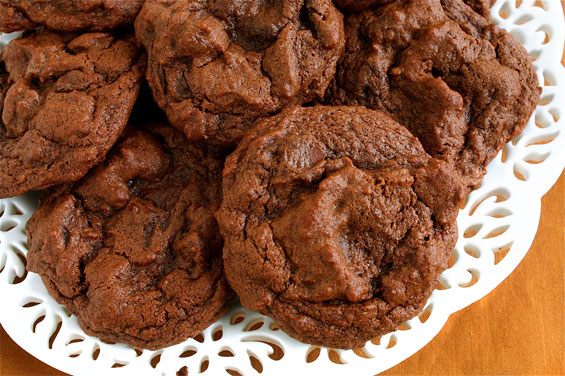
Any day with homemade cookies is a good day. Last week a troop of freshmen appeared in our office bearing plates laden with chocolate chocolate chip cookies. Clearly, these freshmen have good taste.

chocolate chocolate chip cookiesWe didn’t know what to make of them at first. I work in an administrative office at a university, and we generally only see students when they are lost or in serious trouble. These young men and women had baked cookies for everyone in the building, all four floors, to show their appreciation “for everything you do for us.” I’m sure most of them have no idea what we do.

Many of us, myself included, tend to dismiss the contribution of those whose jobs we don’t understand. These students took the opposite approach, assuming we were doing something worthwhile on their behalf, a generosity that meets or exceeds that of baking dozens of cookies for people you don’t know.

I think the world would benefit from more random acts of appreciation. They should probably be done regularly, like flossing. They could be simple, like thanking the person who checks my groceries with more than a mumble instead of interacting solely with the credit card machine.

One blogger has taken it a step further in her Year of Kindness campaign. She does things like buy a complete stranger a cup of coffee because he looks sad or give away dozens of roses to whoever will take them. I’m probably not that advanced yet, but I could start by recognizing those people who help me regularly rather than taking them for granted.

When the cookie bearers stepped off the elevator, the atmosphere on our floor suddenly became Disney-worthy — sun shining, birds singing. I found myself asking everyone, “Did the students come to your office?” That kind of good cheer is worth spreading.

A Little Perspective Goes a Long Way

If I could regularly follow my own advice, I could give the Dalai Lama a run for his money. Holiness is, after all, a competition.

Unfortunately, regularly doing anything is not my strong point. Last week I finally stressed myself out to the point of getting sick (remember that report?). On the fifth day, I was well enough to despair over all the lost time and uncompleted tasks and spent some time railing against the injustices of the world. Then a moment of lucidity bubbled up from somewhere: perhaps I was overreacting considering people live with chronic illness and pain.

My friend, we’ll call her Deidre, has MS yet is sincerely and consistently positive. She manages to be grateful for impossible things like dirty diapers, which remind her the baby is more important than whatever she happens to be doing. She enjoys doing the dishes because it gives her meditative time with God. I often want to throttle people who espouse this type of attitude; not many who say it truly mean it.

I suspect Deidre’s genuine gratitude has its roots in her deep acceptance of her own humanity. She once told me wise choices come from making lots of mistakes. She manages to be happy with who she is even though she can no longer take a hot shower, occasionally has to use a walker, and sometimes literally cannot connect to the right word while speaking or reading because her nerves misfire.

You’d think someone in Deidre’s situation would need more than she has the capacity to give, but that’s never been my experience. I always leave our visits enriched, having gained some wisdom to tack on the refrigerator and reread until I’ve reached the maturity level necessary to practice it.

So next time I’m sick for five whole days and have to suffer through my mom bringing me soup and movies, perhaps I can feel a speck less sorry for myself. Take that, Dalai Lama.

Starting the Season Right

I almost subjected you to deep thoughts this week. Nothing cures unnecessary deep thoughts like a good party, and no one throws a better party than Central Coast Soccer. I highly recommend parties over deep thoughts. First of all, there’s more food. Second of all, people are enjoying themselves.

soccer ball with Santa hatHere is what I love about CCSoccer: it is coed; we don’t keep score; the league asks anyone who is too aggressive to leave; newcomers to the game are welcomed, encouraged, and passed to; everyone on the team having fun trumps playing the best possible game. This truly recreational atmosphere is as rare as a cheerful Woody Allen movie, one out of every few thousand.

Here is what I love about the CCSoccer party: it takes a moment to recognize people because they’ve blow-dried their hair and no one is sweaty. Greetings resemble those between long-lost friends whether people haven’t seen each other for a year or they just played together Wednesday night. Everyone brings their kids, who get to run around and play and be kids. Stealing during the white elephant gift exchange is merciless. The food is really good.

The attitude of the league creates the ambience of the party. The members of this community have practiced not taking one another too seriously, and all the time they’ve spent together, they’ve spent doing something they love—a rare combination.

I don’t know the details of these people’s lives the way I know those of my closest friends or family members, but whether I only exchange hellos with someone or the conversation continues through year-in-review updates, seeing each person cheers me. The smiles and hugs throughout the room make it clear others feel the same way.

If the spirit of the holiday season includes welcoming, supporting, and enjoying those around us, this group is ready to celebrate.

Get Your Gratitude On

To get us all in the mood for the holiday, here is a brief selection from the long list of things I’m grateful for.

CornucopiaThe sense-able: the sun’s warmth on a cold day, the contour of a rock pressing through the sole of my shoe, my sister’s laugh, the impossible whir of hummingbird wings, the oboe playing out over the rest of the orchestra, cat purrs, the smell of freshly-baked bread, the scent of the air after a good rain, the way a warm chocolate chip cookie melts around your tongue, the taste of fried squash blossoms or a perfect peach, the clarity of the milky way on a cloudless mountain night.

The less tangible: early morning silences, the lift of my spirit when a hawk circles, the way a wildflower or sunlight through fall leaves calls me back to the present, the impatience of tree buds ready to burst into life, the satisfaction of a well-placed word or well-struck soccer ball, the way a line of poetry can grab me somewhere between my heart and my bones, the anticipation of leaving on a journey, the comfort of returning home, the moments of feeling all is right in my pocket of the world.

The often overlooked: running water, hot running water, cleaning machines of all kinds, well-maintained roads, airplanes, laughter, peaceful sleep, dentists, antibiotics.

The essentials: so much food I have never once worried about going hungry, clean drinking water, shelter, heat, work, freedom to relate to God as I choose, time to create and the freedom to decide the form of that creation.

The even more essentials, a.k.a. family, friends, and blog readers: your encouragement, your support, your humor, your patience, your forgiveness, your generosity, your love, you.

Happy Thanksgiving, everyone. Joyful feasting.

Just Five Minutes

I have a little problem with cleaning. A few months ago, a couple of friends gave me some good advice: spend fifteen minutes a day cleaning and the house will be in shape before guests arrive. I shortened it to five. Then things got a little out of control.

I liked the idea so much that my list of five-minute-a-day tasks would now take approximately 28 hours to complete. And no, I never even did the cleaning part.

Trying to be hyper-productive, useful, scheduled, and organized doesn’t really work for me. (The results are well and hilariously illustrated on Hyperbole and a Half.) I know people who are naturally this way, and surprisingly I like these people. But when my five-minute-a-day list starts to grow, I am likely trying to make myself OK by achieving all my goals right now. Which means, of course, that whatever I am now is not OK.

Albert Einstein supposedly said, “We cannot solve our problems with the same level of thinking that created them.” The extreme five-minute-a-day approach definitely stays at the same level; it reinforces the not-OK assumption and buys into the achievement myth big time.

Playing, relaxing, praying, and being grateful truly change my thinking. They don’t have much use for not OK because they’re pretty excited about how amazing and fun life is.

When I picture my fully-achieved life (cue background music of heavenly choirs), I feel content. I used to think content was a bad word because it meant stasis and complacency and sitting on the couch eating potato chips and watching endless TV, but maybe it’s just a change in thinking. Maybe it’s gratitude run rampant.

And maybe I should practice it now so that on that day when my kids happily inhabit my clean house and my novel is published to great acclaim, I won’t be taken too much by surprise.